In Kinshasa, Art Takes Shape in a World in Flux
The group exhibition Territories of the Living – Fragments of a World in Flux, curated by Édith Congane at the Centre Wallonie-Bruxelles in Kinshasa, explores ecological and environmental challenges through what emerges as a laboratory of visual resistance. Bringing together 60 works, the exhibition choreographs the practices of seven Congolese artists: Simplus Ntoto, Aïcha Muteba, Papy Tamba, Baba Tshikama, Savio Banza, Jérémie Kuminua and Patrick Kusakana. The exhibition runs until 13 September.
Territoires du vivant – Fragments d'un monde en mutation
The project unfolds at the heart of Kinshasa’s vibrant contemporary art scene. In this rapidly changing metropolis, artists are increasingly engaging with environmental concerns. Far from being merely an aesthetic choice, the reuse of materials has become a political and social practice — a means of documenting the urgencies of everyday life. The exhibition offers no single definition of the environment. Instead, through the diversity of its artistic approaches, it resonates with contemporary theories of environmental philosophy, notably Félix Guattari’s concept of ecosophy¹, in which environmental ecology cannot be separated from its social and mental dimensions.
Identities in Flux
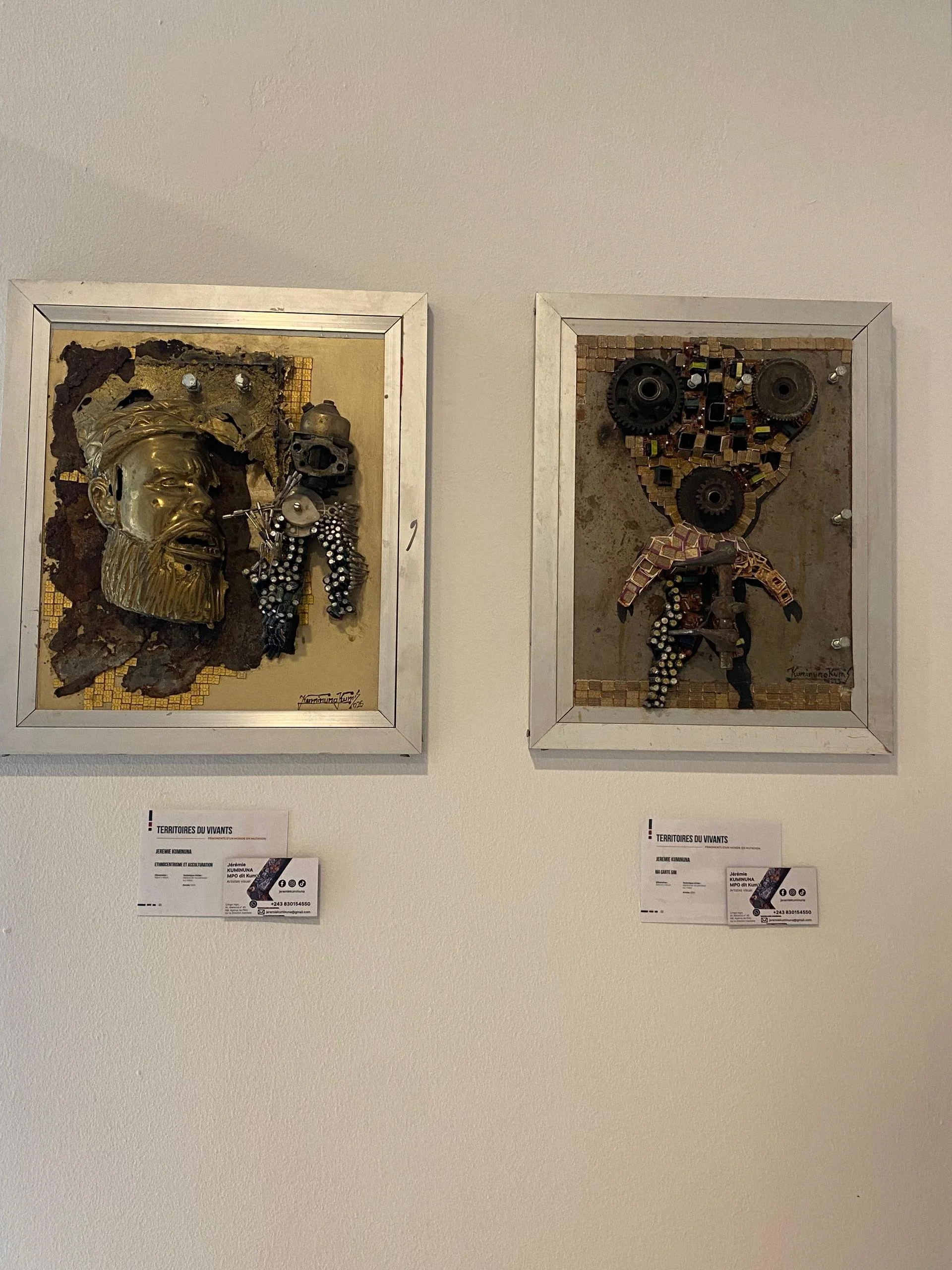
One of the exhibition’s most striking features is its immersive scenography, built around a subtle interplay between constraint and emptiness. In the interior galleries, the display rejects the distancing effect of conventional plinths, bringing the viewer into raw proximity with the materials themselves. Jérémie Kuminuna’s bas-reliefs exemplify this approach, creating a junction between traditional statuary and technological obsolescence. By embedding a gilded metal mask amid cascades of electronic capacitors and sheets of rusted metal, Kuminuna goes beyond a critique of acculturation to reveal how digital waste has become embedded within contemporary identity.
This exploration of shifting identities also emerges in Patrick Kusakana’s paintings. Through figures wearing traditional headdresses against textured yellow backgrounds, he examines African cultural heritage and its resonance in the contemporary world. His work reminds us that collective memory is itself a precious ecosystem — one that must be preserved in the face of the crises of the present.
Territoires du vivant – Fragments d'un monde en mutation, Jérémie Kuminuna
Emptiness as Material
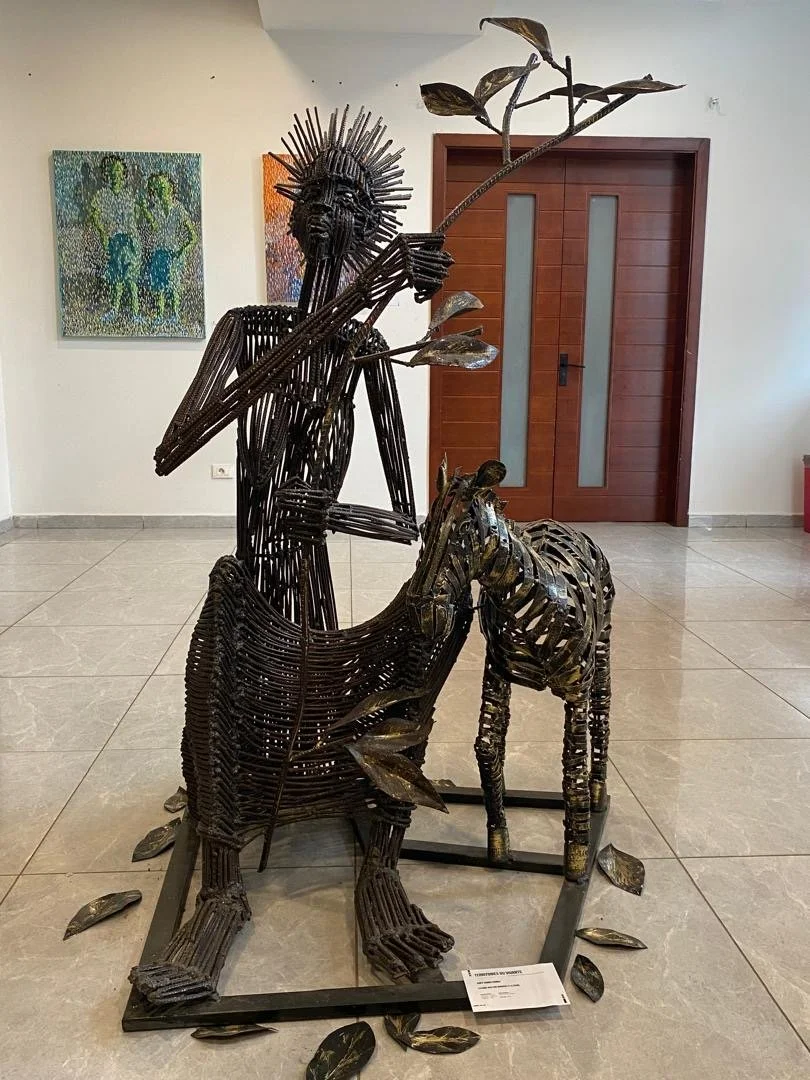
The tension between flesh and industrial matter finds an inverse expression in the work of Papy Tamba. Where Kuminuna accumulates materials to overwhelm the relief, Tamba uses iron to sculpt emptiness. His monumental structures — whether a balafon player or a walking figure flanked by the wireframe form of a zebra — trap air within cages of welded metal. Here, emptiness becomes a material in its own right, a metaphor for disappearance. Light passes through these transparent bodies, casting shadows across the floor, alongside a scattering of golden leaves poised to fall, like symbols of a domesticated nature.
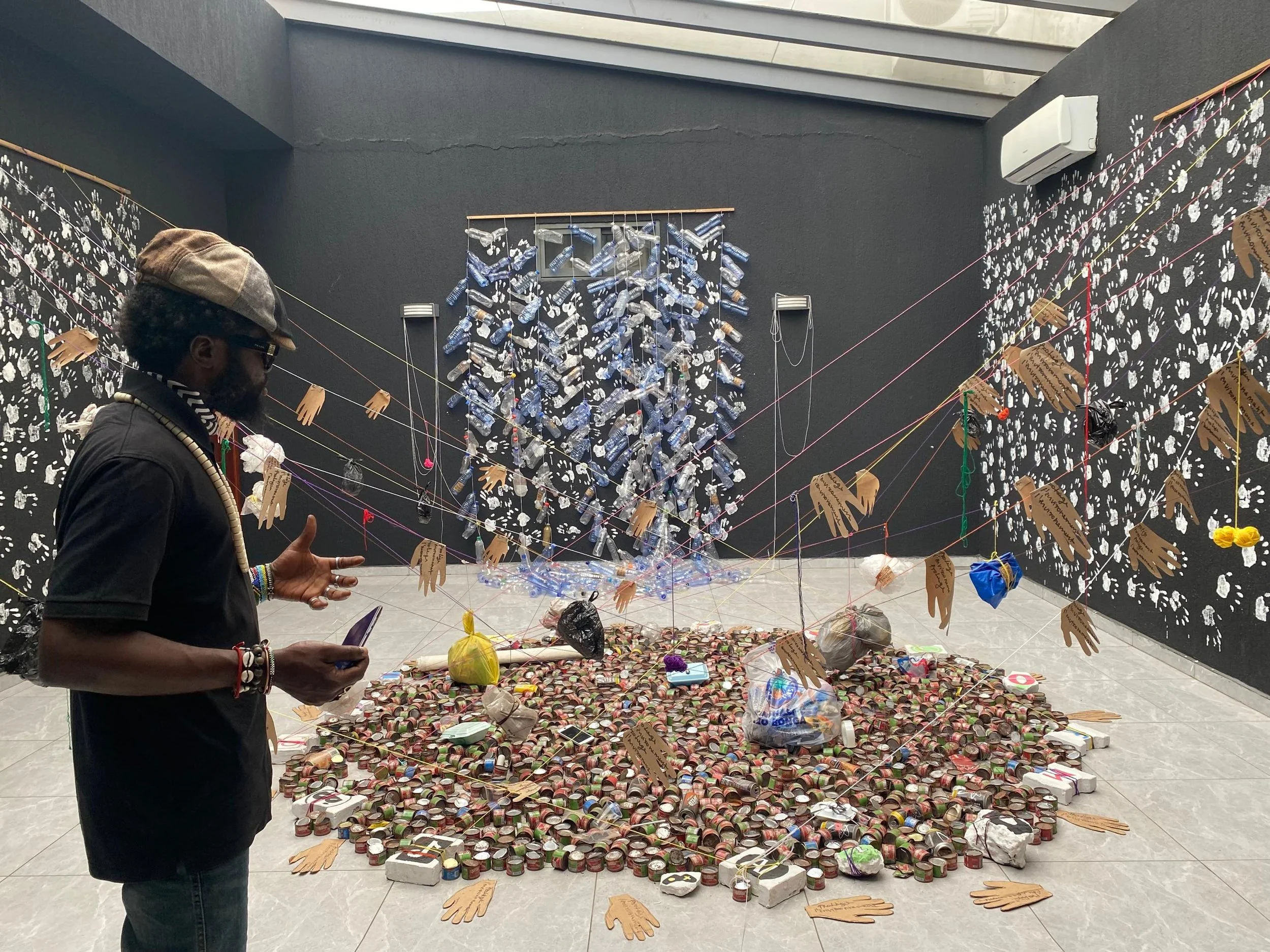
The exhibition reaches a turning point in the courtyard with Aïcha Muteba’s monumental installation, which forms the conceptual and spatial centre of the show. Muteba unfurls an immense three-dimensional spider’s web made of taut threads connecting the open sky, walls marked with white handprints, and a mass of discarded cans and plastic bottles. The threads become vectors within an ecosystem of responsibility: each coloured line connects the consumer’s actions to the realities of urban pollution. Cardboard hands suspended within the web point towards the viewer, pulling them out of the passive position of spectator and confronting them directly with the unfolding disaster.
This gesture of accusation recalls Hans Jonas’s “principle of responsibility”², which establishes the duty to preserve and an awareness of the future consequences of our actions as immediate ethical imperatives. Muteba’s paintings within the gallery extend this entanglement between human beings and nature. Her portraits — their tawny faces crossed by restless, nervous lines — emerge from richly coloured backgrounds saturated with tropical foliage, evoking the intimate ties that bind humanity to its environment.
“By translating ecological crises into formally rigorous artistic propositions, Territories of the Living demonstrates that Kinshasa’s emerging art scene does not simply endure the transformations reshaping the world. ”
Territoires du vivant – Fragments d'un monde en mutation, Papy TAMBA
The Voice of Poetic Dissolution
If Aïcha Muteba chooses the language of direct confrontation, Baba Tshikama takes the path of poetic dissolution. In contrast to Muteba’s monumental, three-dimensional installation, Tshikama turns to painting with remarkable technical precision, building his compositions through small, stick-like strokes of colour reminiscent of batonism. In one work, depicting the hindquarters of an okapi disappearing into the bush, the surface is saturated with thousands of vertical, multicoloured strokes. The animal no longer faces the viewer; it turns its back, gradually dissolving into its own environment. Where Muteba uses thread to bind human beings to their responsibility, Tshikama uses the painted mark to evoke the silent disappearance of wildlife in the face of human encroachment.
Simplus Ntoto gives material form to the disappearance of wildlife in an entirely different way. In contrast to Tshikama’s subtle pictorial camouflage, Ntoto places a massive, life-size rhinoceros in the entrance hall, directly facing the centre’s main doors. The animal’s skin forms a marquetry of textured fragments, compacted salvaged materials and earthy sediments. The rhinoceros becomes a fossil of our time — an architecture of debris that imitates the living world only to make its fragility all the more visible.
A Laboratory of Visual Resistance
This vast collective visual allegory finds its grounding in lived reality — and its documentary force — in Savio Banza’s multidisciplinary practice. Banza’s bas-relief collages push the artistic use of discarded materials to its limits. By shaping portraits and silhouettes from crumpled plastic bags, in shades of green, yellow and black, the artist gives form to the very material that clutters the city.
Through photography, Banza also captures the stark image of a city dweller walking alongside a Kinshasa drainage channel choked with a tide of plastic bottles. In doing so, he reminds us that the starting point for these aesthetic investigations is not an imagined reality constructed in the studio, but the street extending just beyond the gallery walls. This documentary approach unfolds through a series of direct, unembellished photographs and recycled textures — tangible records of urban saturation.
Together, the seven artists transform industrial waste and the frenzy of the metropolis into a laboratory of visual resistance. By translating ecological crises into formally rigorous artistic propositions, Territories of the Living demonstrates that Kinshasa’s emerging art scene does not simply endure the transformations reshaping the world. Drawing from the material realities of the city itself, these artists are forging a powerful visual language through which to confront them.
Territories of the Living — Fragments of a World in Flux runs until 13 September at the Centre Wallonie-Bruxelles in Kinshasa.
References
Eddy Banaré, “Félix Guattari, Qu’est-ce que l’écosophie ?,” Lectures [Online], published 23 January 2014, accessed 22 August 2026.
Nicolas Tenaillons, “Le principe de responsabilité chez Hans Jonas, c’est quoi ?,” Philosophie Magazine [Online], published 17 January 2026, accessed 22 August 2026.