The Resilient Spectres: Manuella Alonge and Destin Ushindi in Kinshasa
At Texaf Bilembo in Kinshasa, Manuella Alonge and Destin Ushindi, recipients of the Collection Gervanne + Matthias Leridon grants, are invited to bring their practices into dialogue. Moving between the deconstruction of colonial archives and graphic chronicles of the conflict-scarred provinces of eastern DRC, the two artists reveal a Kinshasa art scene of remarkable conceptual maturity. Une résidence, deux expressions plastiques is on view until 30 November 2026.
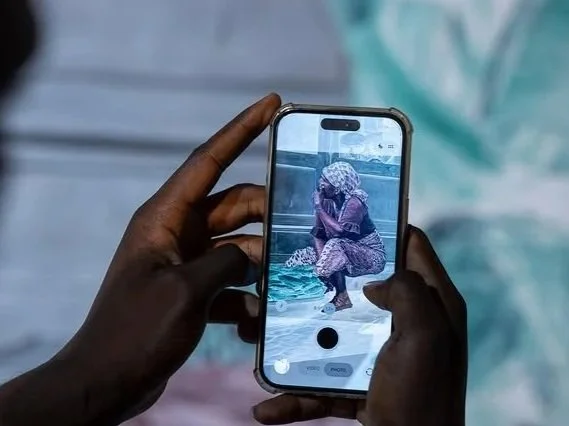
Une résidence, deux expressions plastiques, Manuella Alonge and Destin Ushindi. Courtesy of Collection Gervanne + Matthias Leridon
At Texaf Bilembo in Kinshasa, the two recipients of the Collection Gervanne + Matthias Leridon grants bring their respective practices into dialogue. Between the deconstruction of colonial archives and graphic chronicles of the conflict-scarred provinces of eastern DRC, Manuella Alonge and Destin Ushindi trace the contours of a Kinshasa art scene of formidable conceptual maturity. The exhibition, Une résidence, deux expressions plastiques (One Residency, Two Artistic Expressions), is on view until 30 September.
It is a face-off that speaks volumes about the vitality of Kinshasa’s art scene. At the cultural space Texaf Bilembo, which over the years has become something of a barometer for the Congolese capital’s shifting aesthetic currents, a chiaroscuro scenography stages a dialogue between two distinct trajectories—even if the spatial arrangement stops short of fully delivering on its dramatic promise.
On one side, a black wall, dark as volcanic rock, holds Manuella Alonge Kanwanya’s dense, materially saturated compositions. Opposite, a white wall carries Destin Ushindi Mpigiri’s luminous, almost spectral canvases. Both artists emerged from the Académie des Beaux-Arts de Kinshasa and have also benefited from the support of the Gervanne + Matthias Leridon Collection. Yet where Alonge undertakes an introspective journey through memory—at times recalling the archival collage practice of renowned Congolese artist Sammy Baloji—Ushindi offers an urban and political chronicle.
The Vertigo of the Negative
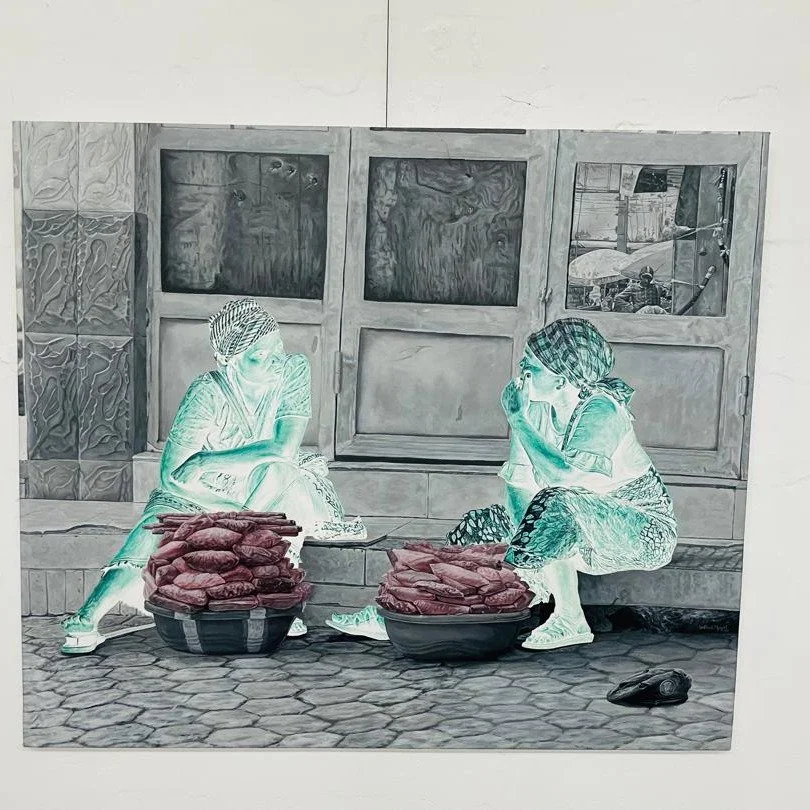
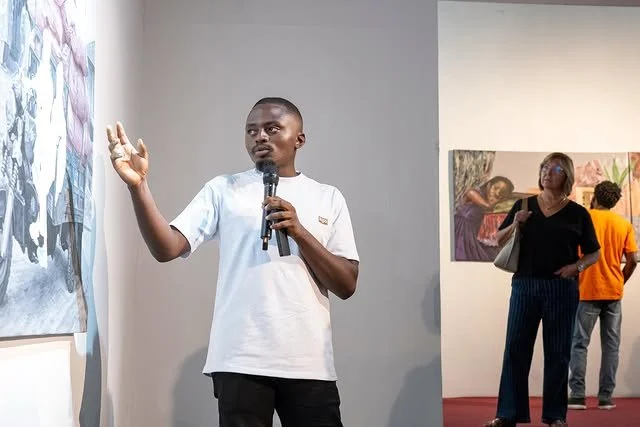
Destin Ushindi’s artistic process deserves closer attention. At first glance, the large-scale works from his Kuvuka series (“to cross” in Swahili) resemble photojournalistic images from Goma or Bukavu. They depict familiar scenes from the urban ecosystem of the Kivus: a tricycle overloaded with bundles of goods hurtling along a dusty road (Série Niko. Kuvuka 1); women traders talking behind makeshift stalls (Série Niko. Raconte-moi); or the organised chaos of a livestock market (Série Niko. Nyabushongo).
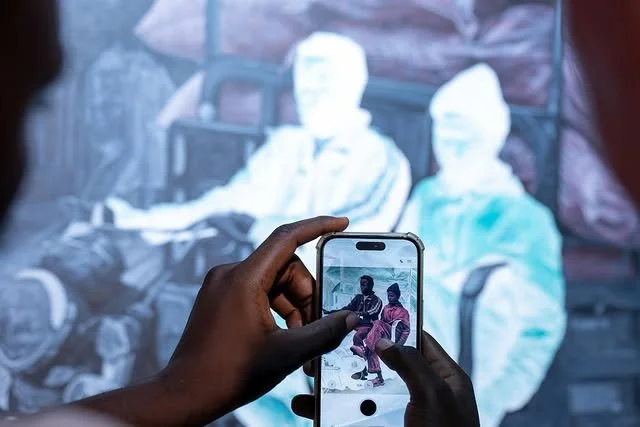
But Ushindi resists the trap of documentary miserabilism. Through a sophisticated pictorial treatment, he reverses tonal values to evoke the aesthetic of a photographic negative. Against this monochrome ground of greyish, almost funereal tones, the artist intervenes with a vivid green ballpoint pen. The effect is striking: the bodies of drivers and market women radiate with an electric, green, almost phosphorescent light.
The gesture is more than a feat of draughtsmanship; it is profoundly political. In a region scarred by three decades of armed conflict and the relentless exploitation of mineral resources—coltan and cobalt, essential to our smartphones, which the artist indirectly invokes through QR codes embedded within the exhibition—the figures become resilient spectres. They are “ghosts” whom war threatens to erase, but whom the obsessive stroke of the ballpoint pen forcibly returns to the realm of the living.
Ushindi does not depict violence head-on. Instead, he makes its intangible presence felt through the very tension of an everyday life that stubbornly persists. He compels the viewer to confront a transfigured Congolese reality, continually oscillating between surreal beauty and the underlying memory of violence.
An Archaeology of Silence
To this poetics of flow and movement, Manuella Alonge Kanwanya responds with an organic, sedimentary materiality. Her work operates as a form of intimate archaeology. The artist examines the mechanisms through which women have been rendered invisible within official histories and national narratives. To do so, she manipulates, fragments and, at times, masterfully reconstructs them.
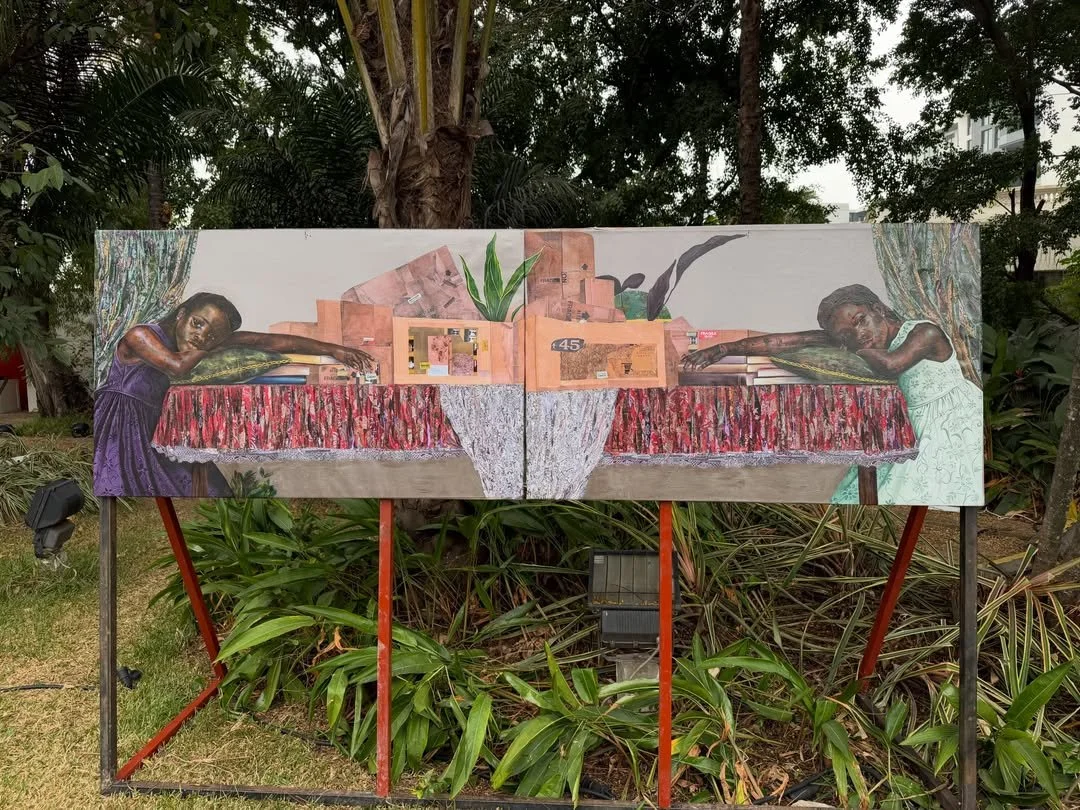
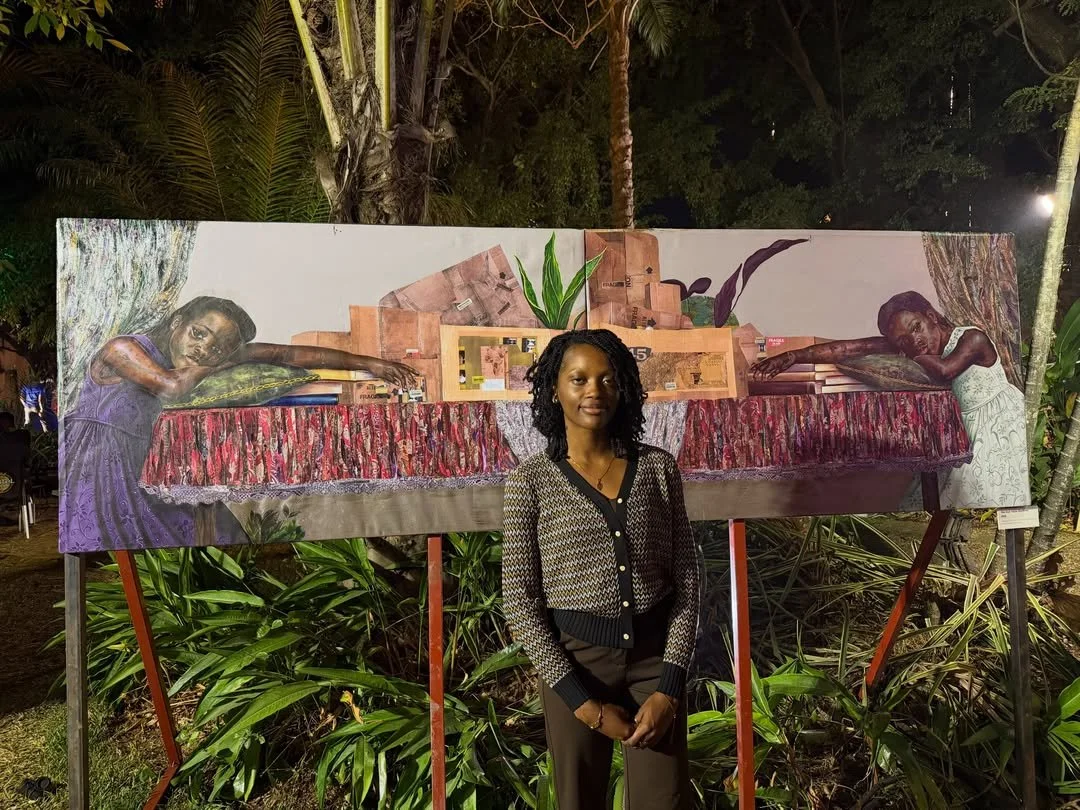
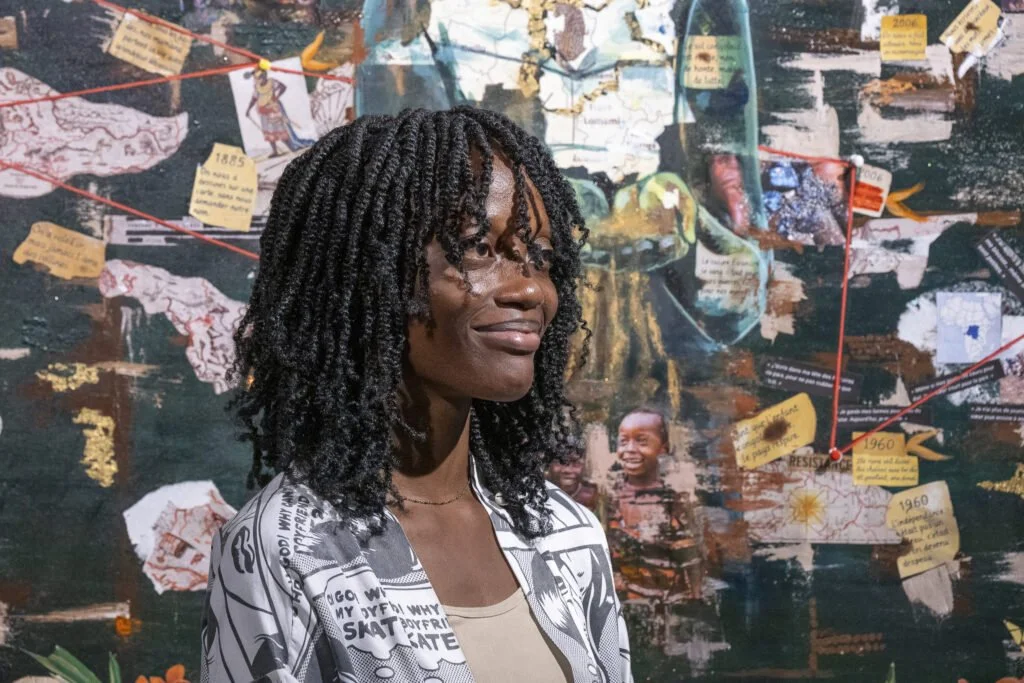
In her Mémoire en transit (Memory in Transit) series, the surfaces of her canvases are built from collaged colonial-era schoolbooks, fragments of obsolete maps and newspaper clippings. Against these textured archives, Alonge stages female figures—often bearing her own features—caught in withdrawn poses or states of profound lethargy. In Mémoire en transit 1, a young woman in a blue dress looks directly at the viewer, her elbow resting on a stack of books, while an unpacked cardboard box bearing the inscription “…lost…” sits before her.
This fragmented memory is not confined to the background; it merges with the subjects themselves. In Mémoire en transit 3, archival images and the textures of newspaper clippings materialise directly on the characters’ skin. Their arms and faces bear the traces of these printed narratives, suggesting that collective history is literally inscribed upon their bodies. Elsewhere, panoramic works such as Table rouge Doctrine unfold across an accumulation of moving boxes stacked behind languid bodies reclining on richly patterned fabrics.
For Alonge, the cardboard box becomes a universal metaphor for uprooting: the mental and physical baggage carried through exile or forced displacement. But the melancholy of these women should not be mistaken for passivity. It is the suspended time of reflection—a form of silent resistance to the grand historical narratives that have sought to erase them. The use of muted, nostalgic tones lends the works the quality of contemporary relics.
Beyond the Ornamental
What is particularly compelling about this two-person exhibition is precisely the way these two practices, both shaped by the same residency experience between Cameroon and Kinshasa, sidestep the pitfalls of decorative painting and thematic opportunism that can at times saturate the international market for contemporary African art. By confronting Alonge’s semantic density with Ushindi’s vibrant restraint, Texaf Bilembo offers far more than an end-of-residency presentation. The exhibition documents a less visible transition: that of a younger Congolese generation reclaiming its own traumas and transforming them into universal critical tools.
These two artists do not simply bear witness to chaos; they rewrite its codes with remarkable command. An exhibition not to be missed.
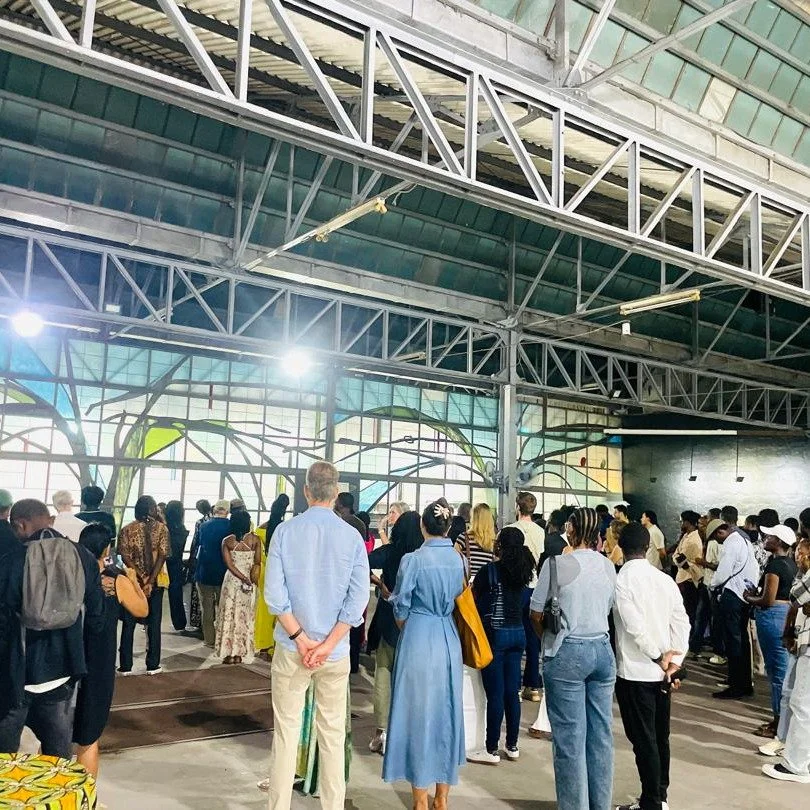
Une résidence, deux expressions plastiques, Manuella Alonge and Destin Ushindi. Courtesy of Collection Gervanne + Matthias Leridon
Une résidence, deux expressions plastiques, on view until 30 November 2026 at Texaf Bilembo.