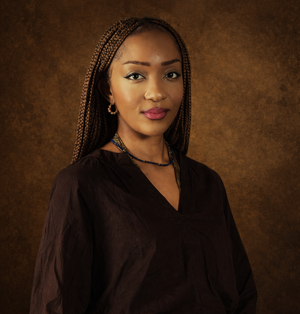
Otobong Nkanga, I dreamt of you in colours : ‘I think of the Earth as a being, like our body.’
What is the essence of a living organism? What binds us to one another? These questions, central to the practice of Otobong Nkanga (born 1974), flow through her entire body of work, now brought into focus in an exceptional monographic exhibition at the Musée d’Art Moderne de Paris. I Dreamed of You in Colors unfolds as a sensitive, immersive journey into the artist’s own cabinet of curiosities. Through a rigorous yet poetic form of research, Otobong Nkanga reveals the invisible threads that connect us and works to re-situate the human being within the biosphere — within a living continuum composed of materials, stories, and interdependence.
Otobong NKANGA
This autumn, and until 22 February 2026, the Musée d’Art Moderne of Paris presents an exceptional monographic exhibition dedicated to Otobong Nkanga, whose work — situated at the intersection of science, ecology, and human experience — resonates with particular clarity in light of today’s global challenges. Through installations, drawings, and sculptures, the artist explores the invisible bonds that connect bodies, materials, and territories, inviting us to reconsider our relationship with the living world and with the Earth’s resources.
Living Organisms
Born in Kano, in northern Nigeria, and having grown up across various cities and countries, Nkanga developed at an early age a heightened sensitivity to territories and their transformations. These repeated displacements throughout her youth have left a lasting imprint on her personal history and form the guiding thread of her practice. Starting from the individual body, she explores the notions of union and interdependence that connect us all, driven by the desire to restore the original bond between humans and the earth. She questions humanity’s imprint on the land — our ways of marking, extracting, and transforming — and reminds us that we exist not outside the living world but as one of its constituent parts. We are one, she seems to say. Drawing on biology, the artist repositions the human within the biosphere: not above it, not beside it, but in relation to it.
Material Exploration
Let us consider Otobong Nkanga’s work as an ongoing form of research, in which each piece offers its own interpretation of the notion of the organism—particularly through her methodical use of materials. Her practice unfolds as a continuous inquiry where matter occupies a central, almost structural role. Researcher as much as artist, Nkanga develops a near-scientific approach to materiality: her travels, residencies, and immersions across different territories become fields of study from which she gathers forms, colors, textures, and stories. From these observations emerge works with universal resonance, capable of weaving a subtle dialogue between intimate experience and global concerns.
This tension between mobility and rootedness shapes the entirety of her practice. By examining the relationships between human movement, the imprint we leave on our environment, and the pressure exerted on natural resources, Nkanga opens a profound reflection on our place within the biosphere and on the interactions that flow from it. A thread gently unfurls, inviting us to follow it—to perceive the echoes, frictions, and connections that compose our world.
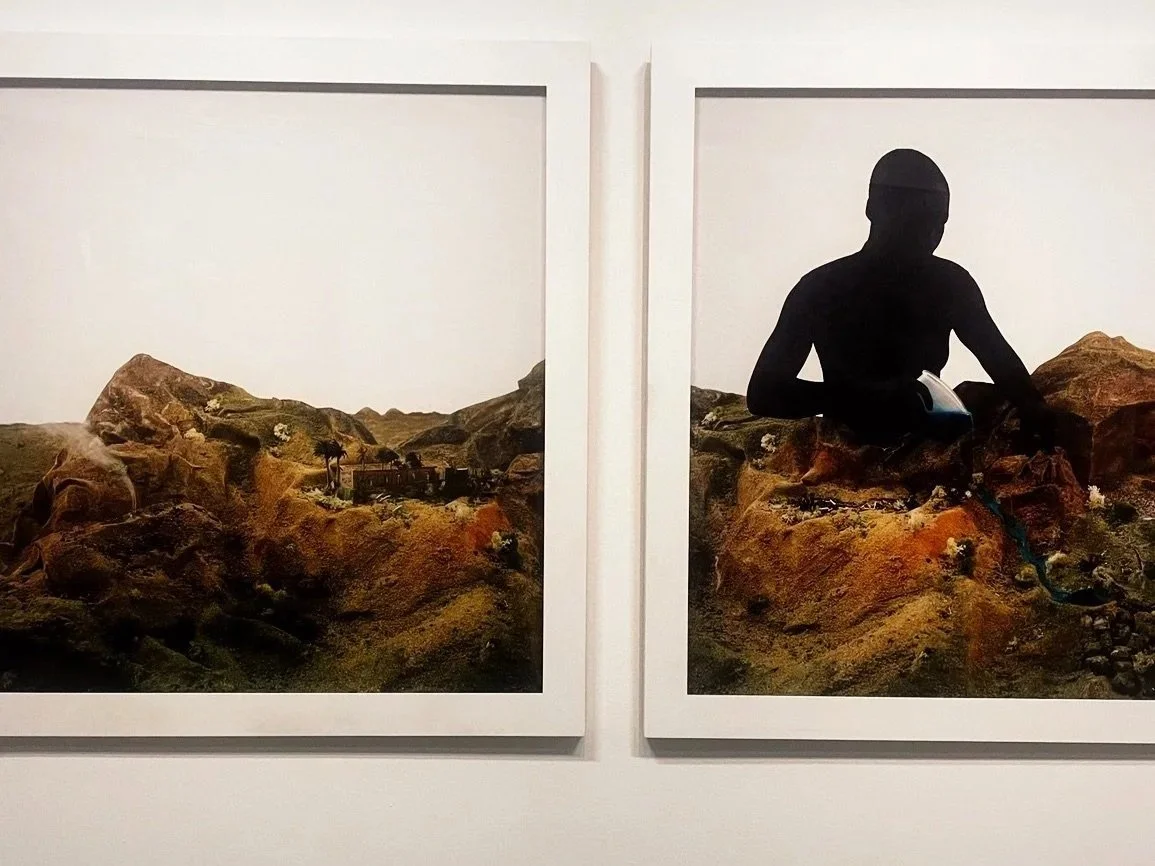
Alterscape Stories, Otobong NKANGA (2006), Credit : Mayi Arts
The Memory of the Earth
In Alterscape Stories, created during a stay in Fuerteventura in the Canary Islands, Nkanga documents the impact of human intervention on landscapes. Her works become living organisms, capturing the erasure of the past, the rewriting of the present, and the projection of a hypothetical future.
The work Tsumeb offers a stark reflection on the consequences of mining exploitation, inspired by her visit to Green Hill—once one of the richest mines in the world, located in the Namibian town of Tsumeb. Beginning in 1907, the site was operated by the German colonial administration. Minerals and ores containing copper, lead, silver, gold, and arsenic were extracted and smelted on-site. Although the mine ceased operations in 1996 due to declining profitability, a polluting copper-smelting furnace continues to function there today, causing serious environmental damage and posing significant health risks to the local population.
On the train leading her to Tsumeb, Otobong Nkanga realized that the railway line had been built specifically to transport minerals to the port of Swakopmund. She would later say:
“The construction of this railway must have cost blood, sweat, and tears […]. In Namibia, as everywhere in the world, humans disfigure the landscape […]. In Namibia, a landscape is mutilated and rocks are crushed, creating a void that reappears elsewhere in another form.”
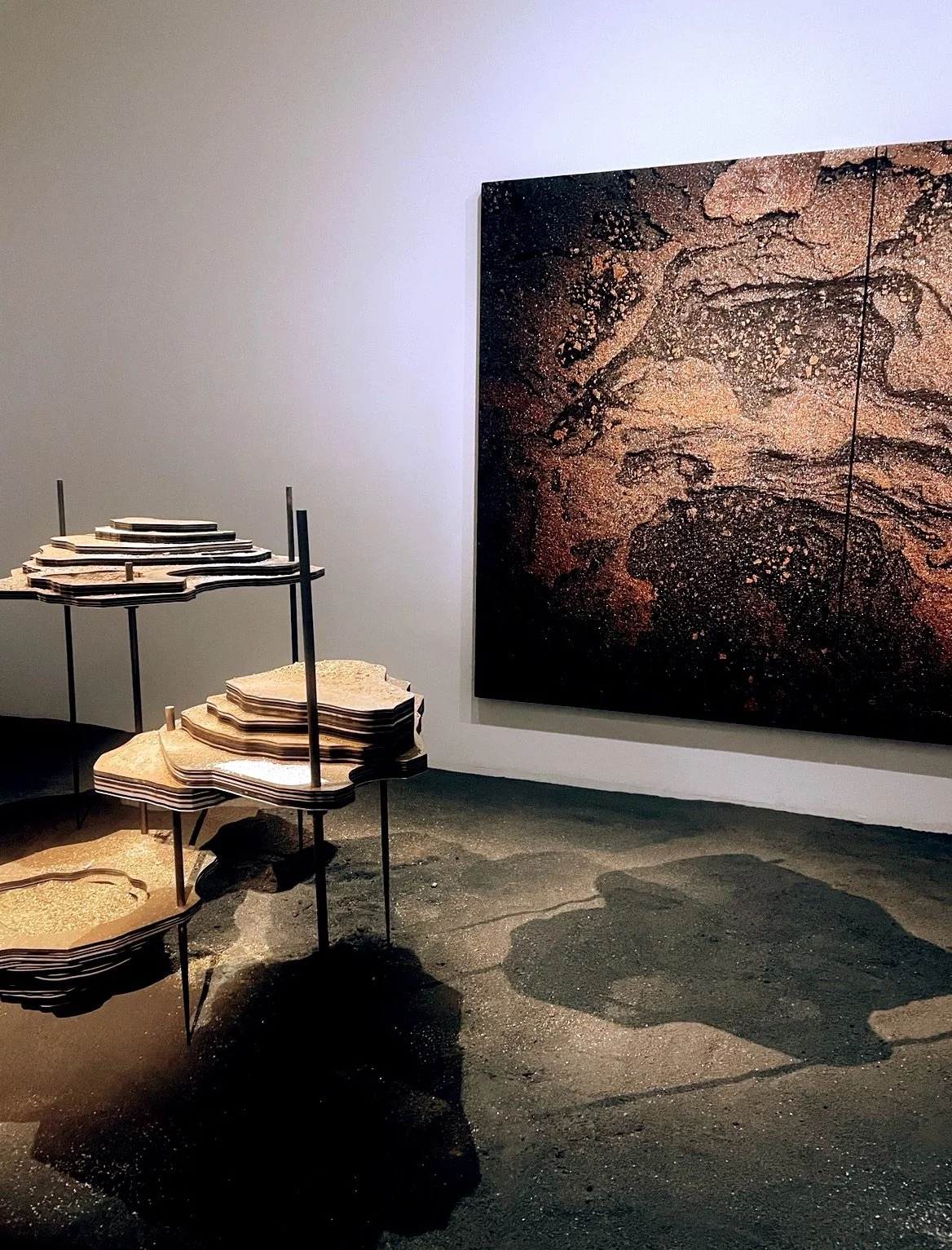
Tsumeb, Otobong NKANGA (2015), Credit : Mayi Arts
Restitutions and testimonies.
Nkanga shares the results of her research with a distinctive rigor. During her residency in Pointe-Noire, she produced a series of fifteen drawings named after the city. These works explore, among other things, the realities and tensions linked to oil exploitation and its impact on Congolese society, navigating the space between fine art and technical topographic drawing.
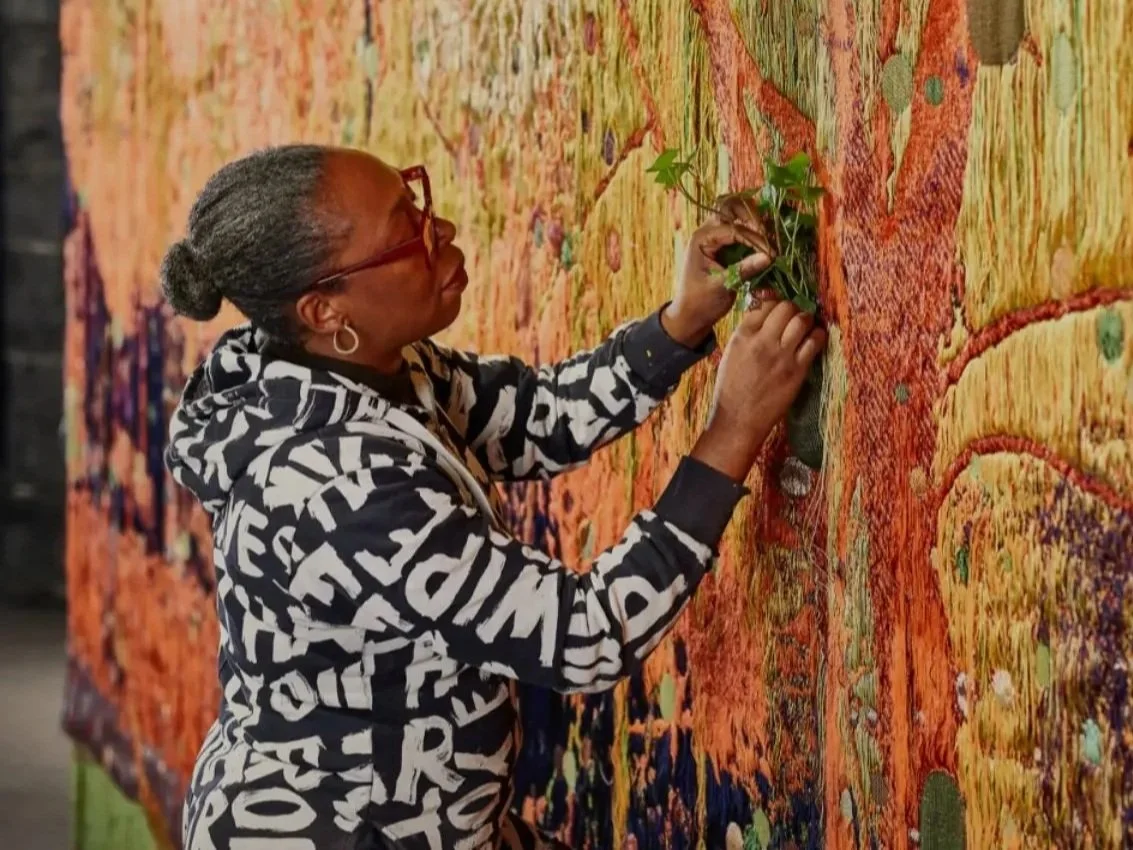
For her solo exhibition in Austria, she turned to textiles, creating a series of four monumental tapestries, each accompanied by plaques engraved with poems — love letters to the earth. Between fibers and pigments, she incorporates living elements — soil, grass — into these “living walls.” These pieces stem from her extensive experiments at the TextielLab of the Textielmuseum in Tilburg (Netherlands). Through soil, mines, seas, and seasons, she tells a story of transformation. To observe nature is, in a sense, to observe oneself. The earth — persistent, fertile — always returns. In Nkanga’s work, the grass inevitably grows back. Her entire practice functions as a poetic, organic laboratory, where art, science, and memory enter into dialogue.
While the narrative underpinning Otobong Nkanga’s research remains constant — weaving together ecological concerns, lines of ancestry, and biological references — certain recurring motifs, true conceptual and visual codes, reappear in each of her works as subtle reminders. Yet each creative project remains distinct: tied to a specific location, rooted in a particular context, and exploring unique materials that enrich the broader scope of her research. Nkanga’s work further emphasizes the imperative for humanity to reclaim its place within the biosphere — not above it, nor at its margins — in order to preserve its balance and sustainability.
I Dreamt of You in Colours, Otobong NKANGA, until 22 February 2026 at Musée d’Art Moderne of Paris.