The Odyssey of Kabhula LANGO: From Goma to Nairobi, A Practice Rooted in Sand and Memory
Inhabiting Displacement. Sand is the material through which Kabhula LANGO (b. 2002) narrates his journey. Within it, he inscribes the traces of a territory, a shared memory and identities in constant motion. At the intersection of figuration and expressionism, his works portray bodies in transit, crowded scenes and landscapes of the subcounscious mind that echo his own journey from Goma to Nairobi.
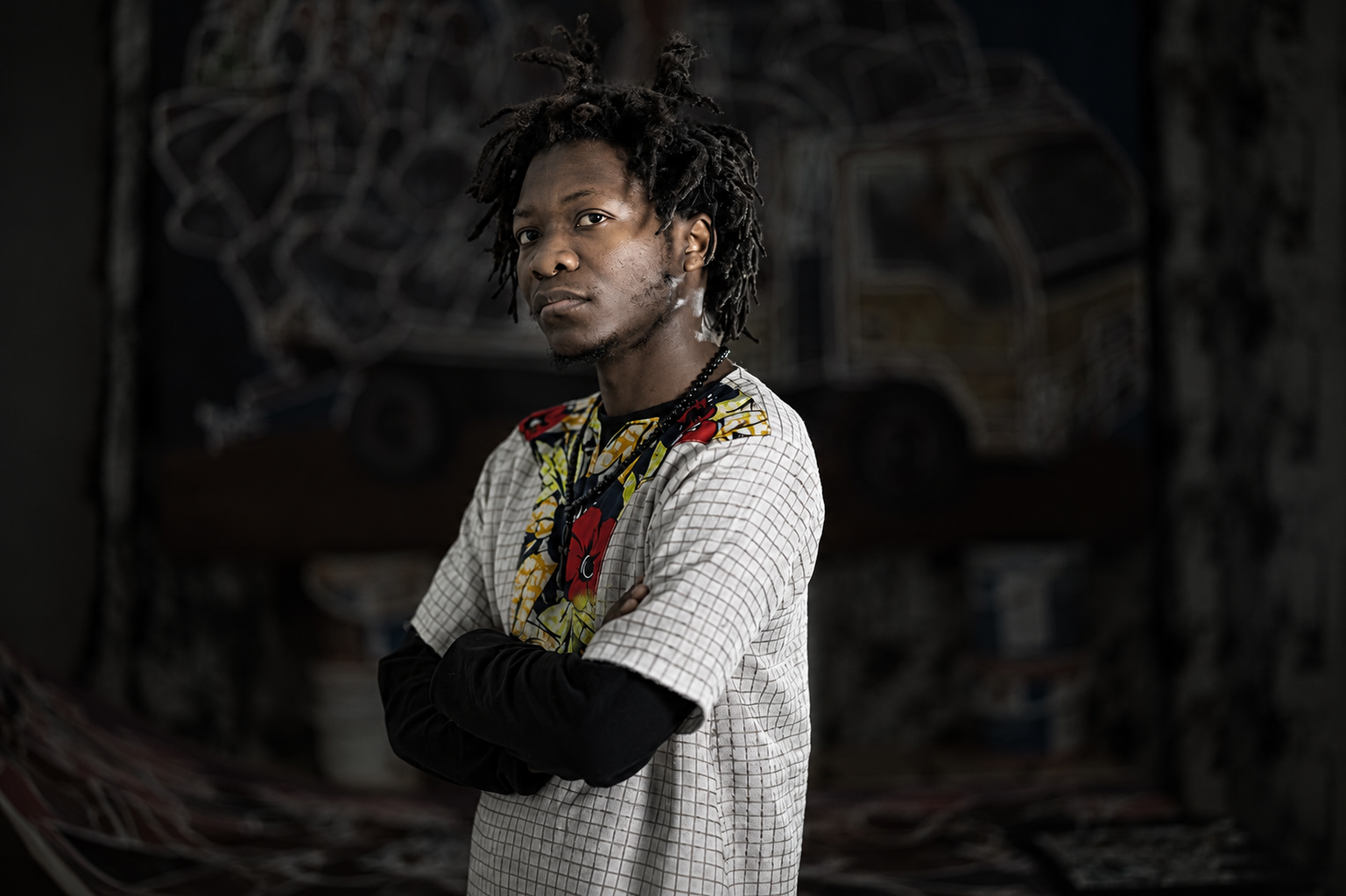
Kabhula LANGO. Credit : John Cuesta, Kay Brown
We meet Congolese artist Kabhula LANGO on the occasion of his first solo exhibition with Circle Art Gallery in Nairobi, the city he has called home for the past two years. Throughout this conversation, he reflects on his journey, from his childhood in Goma to building a new life in here in Kenya, recounting the encounters, influences and formative experiences that have shaped his artistic language.
Yet it would be limiting to describe Kabhula LANGO simply as a visual artist. His practice exists at the intersection of memory, materiality and displacement, where every medium becomes a vessel for lived experience.
His distinctive use of sand has become the defining signature of his work, a common thread reinterpreted across seasons. Far from being a mere aesthetic choice, thie material serves as a way of exploring the memory of his homeland, a region marked by decades of conflict and the exploitation of its mineral resources. Through sand, Kabhula LANGO gives physical form to narratives of migration, resilience and belonging that run throughout his practice.
Ngalula MAFWATA: When we last spoke, two years ago during your residency in Kigali, your move to Nairobi was still just a plan. Looking back, what does that transition represent for you today?
Kabhula LANGO: Leaving Goma was never a spontaneous decision. Nairobi had long been one of the cities I was considering, and the opportunity eventually came through a connection I made in Goma. In the meantime, I also spent some time in Kampala, Uganda, before deciding to settle in Kenya.
Nairobi is an incredibly vibrant city, full of opportunities. The cost of living is certainly higher, but the context is very different from Goma. For an artist, it's an especially stimulating environment.
What struck you most when you arrived on the Kenyan art scene?
Kabhula LANGO: Compared to my hometown of Goma, Nairobi is several steps ahead. What immediately stood out to me was the number of spaces dedicated to artistic creation and the existence of artist-run initiatives, places designed by and for artists, that foster a strong sense of community.
I quickly met people with whom I could exchange ideas and build meaningful relationships. I was fortunate enough to become part of a circle of highly committed artists who approach both their work and their practice with great rigor. Before long, I felt I had found a true artistic family.
Kabhula LANGO: I was born in Goma, into a family where craftsmanship was already part of everyday life. My brothers had an incredible ability to make things with their hands, and I naturally wanted to cultivate that same skill while constantly pushing myself further.
When I was around ten or twelve years old, a master craftsman arrived in our neighborhood. Seeing how involved I already was in making things by hand, my mother introduced us so that I could train under him. He came from the city of Butembo, located in the East of Democratic Republic of the Congo, whose history has long been shaped by the presence of Catholic missionaries. Much of his own work was produced in collaboration with those missionary communities.
He had a remarkably progressive vision of contemporary art and worked with virtually every material imaginable. I spent nearly five years in his studio while he travelled regularly between Butembo and Goma.
Ngalula MAFWATA: What was your apprenticeship with your first mentor like?
Kabhula LANGO: I learned the techniques he taught me very quickly. As time went on, I was even producing complete works that he would sign with his own name in order to keep up with the many commissions he received. I was simply too young to be recognised as an artist in my own right.
Although he wasn't represented in major collections or on the contemporary art scene, he was a highly respected craftsman whose work sold regularly, particularly to tourists.
During that period, I also made the decision to leave my studies in electronics, which I had been pursuing for almost four years at a monastery in North Kivu, so that I could devote myself entirely to art.
“For me, sand is never merely a material; it carries the memory of this land.”
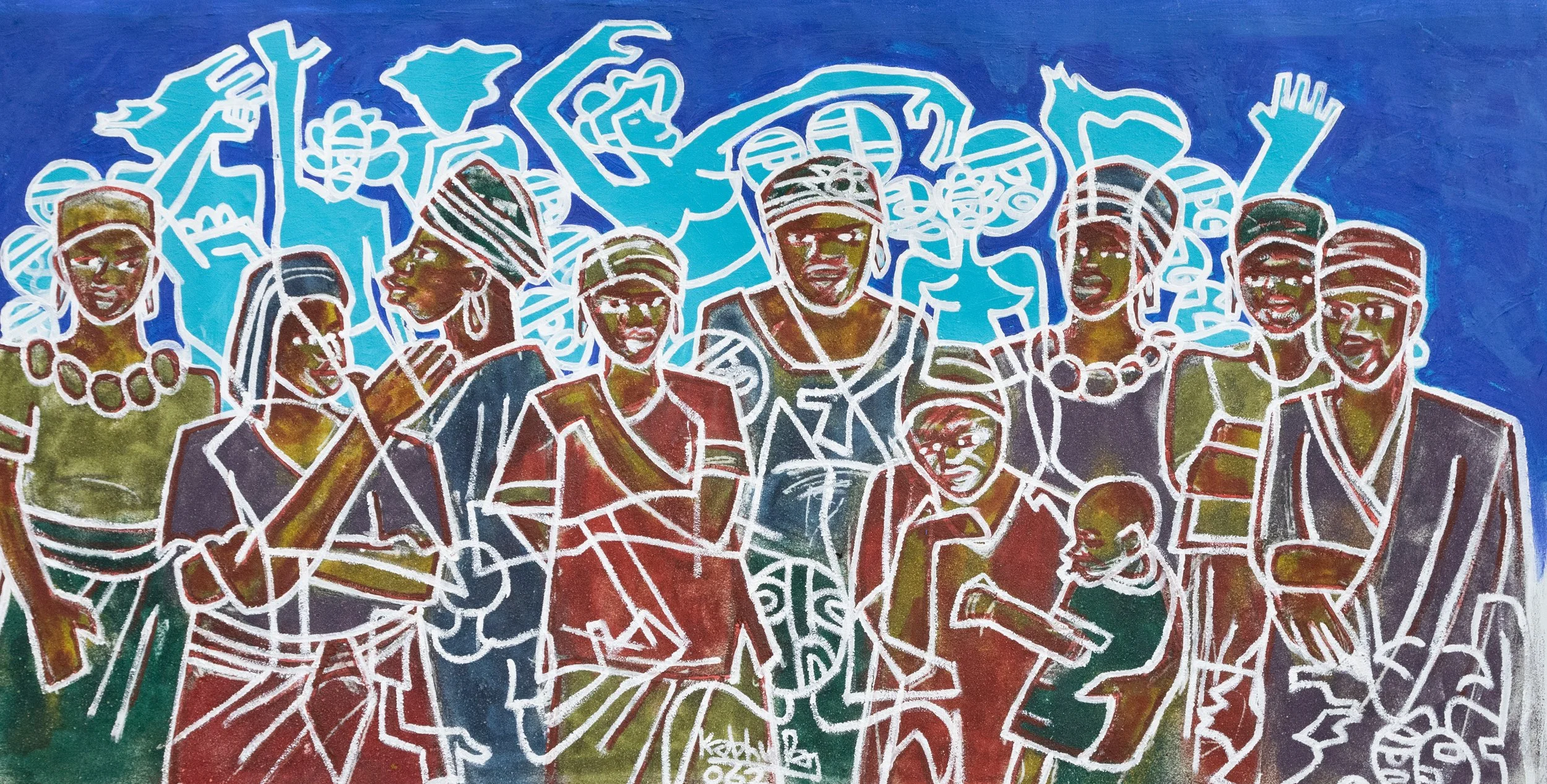
Les filles de Mombi (The girls from Mombi), Acrylic, oil and sand on canvas, 155x76cm, Kabhula LANGO (2026)
Ngalula MAFWATA: How did returning to Goma marked a turning point in your artistic journey?
Kabhula LANGO: When I returned to Goma, I met several artists who had studied at the Academy of Fine Arts in Kinshasa, including Francis MAMPUYA and Denis MATEMO. Through them, I was introduced to composition, art history and a much more structured approach to making art.
Until then, I had mainly been painting landscapes and works intended for tourists. Their teaching allowed me to develop the visual language that defines my practice today. They taught us the art of composition and introduced us to the history of Congolese art. Together with the other young artists around me, we studied the artistic movements that emerged across the country, particularly in Lubumbashi, as well as the work of major figures such as Pili Pili and Mode MUNTU.
Mode MUNTU, in particular, had a profound influence on me. He regularly travelled to Goma alongside other artists from Kinshasa at the invitation of collector Dario Merlo KASUKU, founder of Kivu International School. Those encounters greatly broadened my understanding of art and expanded my vision of what artistic practice could be.
“The boundary between celebration and destruction is almost impossible to define.”
Ngalula MAFWATA: Matter, sand in espescially occupies a central place in your practice today. How did this technique become such a defining part of your work?
Kabhula LANGO: I was trained in a wide range of techniques, including classical painting. Yet it was the use of sand, first introduced to me by my earliest mentor, that came to define my practice. He taught me how to work with materials, banana peels, sand and many other natural elements that today would be considered highly contemporary. At the time, however, this approach was largely misunderstood. Realism dominated, and many people simply assumed that I didn't know how to draw. (Laughs.)
I've remained committed to working with sand because it resonates deeply with the questions I continue to explore about my home region. I have spent a great deal of time reflecting on it. I grew up in a territory shaped by conflict, where mineral resources lie at the heart of longstanding tensions.
For me, sand is never merely a material; it carries the memory of this land.
By incorporating it into my work, I seek to make those realities visible and give them an almost physical presence.

Mask, Untitled, recycled plastic, aluminium and sand on old materials, 35 × 13 cm, Kabhula LANGO (2026)
Ngalula MAFWATA: Displacement is a recurring pattern in your work. How do you experience it personally today, and how has it shaped your artistic reflection?
Kabhula LANGO : For me, displacement begins with questioning. In my case, several realities overlap.
The first is the ongoing conflict in eastern Democratic Republic of the Congo. Goma takeover in 2025 forced many people to leave their homes in search of safety and the possibility of rebuilding their lives. But beyond the war itself, there is also the lack of opportunities that pushes many of us to seek a future elsewhere.
Alongside this is another, quieter reality: the exploitation of mineral resources. It contaminates the land, the water and the air, gradually making certain places increasingly difficult to inhabit. Without water, there is no life. Environmental degradation, desertification and armed conflict are deeply interconnected, each contributing to the displacement of communities. People leave in search of hope—a second chance—while carrying with them the profound desire to remain on the land they call home.
This is the reality I explore in my work Allons-y. It depicts figures walking beneath an orange disc that appears both in the sky and on the ground. They move towards a future they hope will be better, while leaving behind everything that once defined their lives.
That is the paradox of displacement: searching for a new hope while leaving behind the one you already had.
When I arrived in Nairobi, I didn't know exactly what I would find. I simply knew that I had to keep moving forward.
Ngalula MAFWATA: Do you still have family in Goma?
Kabhula LANGO: Yes. My mother has remained in Goma. She prefers to stay there and does not feel that she is in danger. My brothers are now living in Beni, which is currently the provincial capital of North Kivu.

Wachimbaji II, Acrylic, oil and sand on canvas, 100 × 80 cm, Kabhula LANGO (2024)
Ngalula MAFWATA: While sand remains central to your practice, you have recently begun exploring sculpture and masks. What draws you to these new forms?
Kabhula LANGO: I began exploring sculpture and masks during my most recent residency with the Alliance Française. Throughout the residency, I was struck by the presence of sculptural works all around me. The exhibition, Les Matières Voyageuses (Travelling Materials), explored the circulation, transformation and reuse of materials, which resonated deeply with my own practice.
Ngalula MAFWATA: While displacement, migration and geopolitical crises remain at the heart of your work, has living in Nairobi opened up new creative directions? What research is shaping your practice today?
Kabhula LANGO: The themes I explore remain deeply rooted in who I am, but my practice continues to evolve. I've begun developing new lines of inquiry through more abstract forms and a different chromatic palette, introducing pinks, purples and other tones that mark a new chapter in my work. Paintings such as Mafiriki II, for instance, explore the subconscious.
In Vibrations , the work resists a single interpretation. Some viewers perceive violence; others see movement. What interests me most is expressing the sensations created by movement itself. Faces and bodies emerge, intertwine and dissolve into one another.
The boundary between celebration and destruction is almost impossible to define. You might see dancing figures, or bodies entangled in conflict. It is precisely this ambiguity that fascinates me. At times, those two states become indistinguishable. That is the direction in which my work is evolving. It is largely intuitive - almost unconscious - yet it remains deeply connected to my central concerns, only in a more subtle way.

Allons-y, Acrylic, oil and sand on canvas, 300 × 84 cm, Kabhula LANGO (2026)
Ngalula MAFWATA: Earlier, you mentioned finding a community of artists in Nairobi with whom you could exchange ideas and grow. Has becoming part of this new artistic ecosystem changed the way you think about making art or about relationships between artists?
Kabhula LANGO: In the end, I think it's much the same everywhere. Every art scene has its own challenges. There are often close-knit circles that can be difficult to enter. That's true here in Nairobi, just as it is in the Democratic Republic of the Congo.
Looking back, I would say that the opportunities I've had have been, above all, the result of my own determination. In fact, many of the people who have supported me throughout my journey were not artists themselves.
There is also a great deal of competition. Circle Art Gallery is one of the spaces where many Kenyan artists aspire to exhibit. But I believe everyone has their own path. When I first met Danda Jaroljmek, Director of Circle Art Gallery, she immediately responded to my work, just as I was deeply moved by her vision. We've stayed in touch since 2025, and over time that relationship developed naturally into a genuine collaboration.
“Environmental degradation, desertification and armed conflict are deeply interconnected, each contributing to the displacement of communities. ”
Ngalula MAFWATA: Despite the underlying violence that runs through much of your work, there always seems to be a sense of hope. Would you say that hope is the thread that ties your practice together?
Kabhula LANGO: There is one work that perhaps captures what I am trying to convey more than any other: Vibrations. I'm always pleased when people connect with my work, but even more so when it sparks curiosity.
I still consider myself a young artist with a long journey ahead of me. I hope to continue growing my career, but I'm also someone who believes in patience and remains open to advice. Art takes time, and so does an artistic practice.
Explore Transmission, Kabhula LANGO's latest exhibition with Circle Art Gallery, now available to view on Artsy.