Dakar Biennale 2026 : (Anti)Fragility: Arts of Repair and Counter-Shock Strategies, The Selected Artists
The 16th edition of the Dakar Biennale will take place from 19 November to 19 December 2026, under the theme “(Anti)Fragility — Arts of Repair and Counter-Shock Strategies.” On 24 September, the artists officially selected for this new edition were announced, offering a first glimpse into the artistic and curatorial vision shaping Dakar 2026.
DAKAR 2026: BETWEEN MEMORY AND CREATION
The selection of artists for the 2026 Dakar Biennale was unveiled at the Museum of Black Civilisations, in the presence of the Prime Minister and Bacary Sarr. The choice of venue carried particular significance in a city whose cultural history remains deeply connected to the legacy of the First World Festival of Black Arts in 1966, and to the histories and narratives linking Africa and its diasporas.
Through this new edition, the Biennale seeks to reaffirm Dakar as one of the major crossroads of international contemporary creation — a platform from which contemporary African art can articulate its own narratives, and where memory and creation enter into dialogue.
Among the initiatives presented was Le Voyage, conceived to open up new spaces for artistic creation and extend the Biennale’s dynamics beyond its established framework.
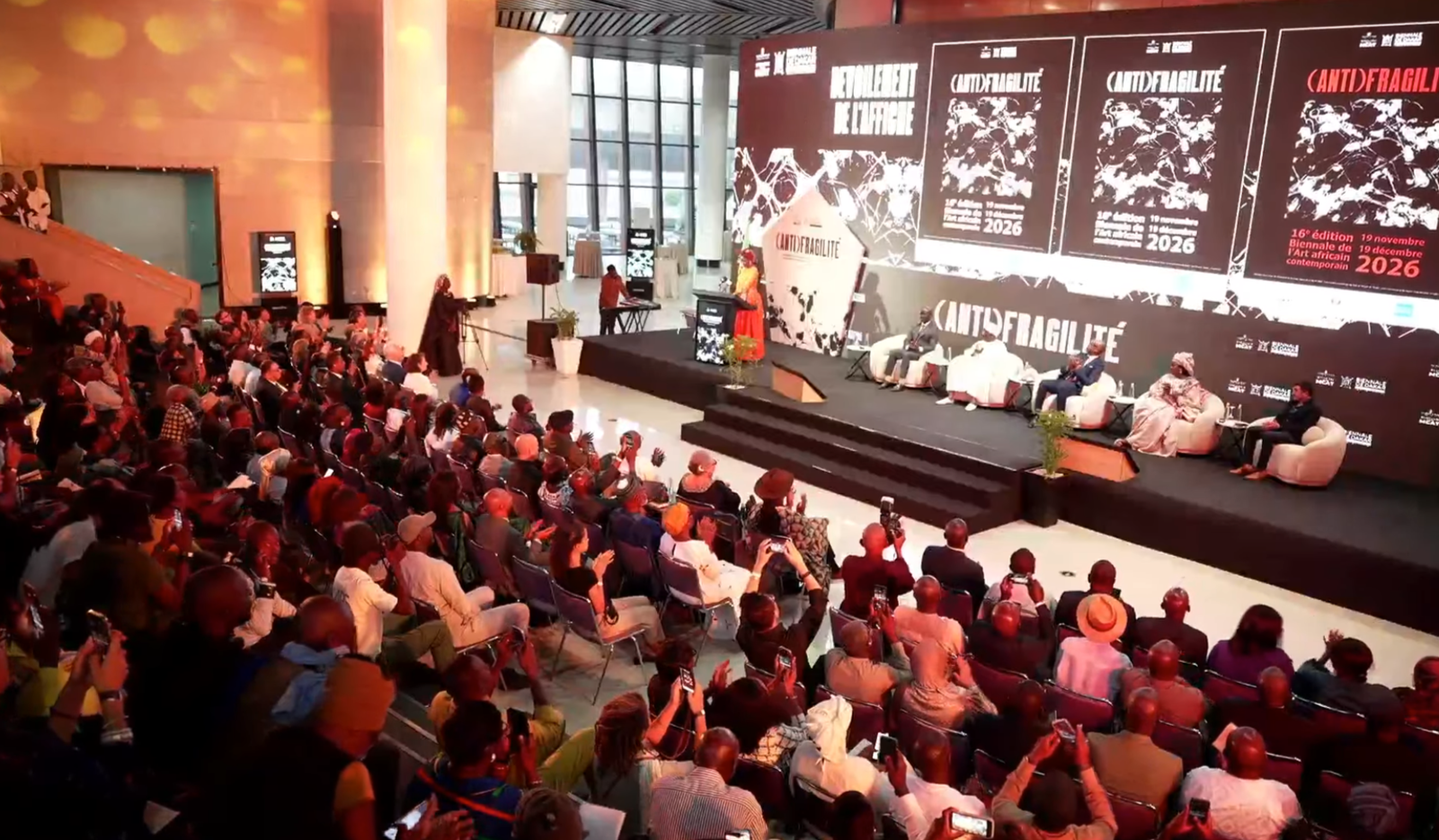
The official poster for the Dakar Biennale 2026
75 SELECTED ARTISTS
Georges Adéagbo — Benin
Victor Adewale — Nigeria
Faitha Al Zemmouri — Morocco
Nia Hampton — United States
Dela Anyah — Ghana
Joey Aresoa — Madagascar
Kolawolé Dagbé Mikhaël ATCHO — Benin
Ismaïl Bahri — Tunisia
Nú Barreto — Guinea-Bissau
Hady Barry — Guinea
M’barek Bouhchichi — Morocco
Catherine Boyer — France
Ernest Breleur — France / Martinique
Ibrahim Cissé — Senegal
Kelechi Agwuncha, Kesiena Wanogho — Nigeria
Neve Insular — Cabo Verde
Studio Dialogues — Ghana
Sabrina da Silva Medeiros — Brazil
Caroline Déodat
Rashid Diab
Aliou Diack — Senegal
Serigne Ibrahima Dieye — Senegal
Pape Diop x Laladou Boye Diallo— Senegal
Mbaye Babacar Diouf — Senegal
Beau Disundi Nzazi - Democratic Republic of Congo
Safaa Erruas — Morocco
Stéphane Foucaud — France
Eva Diallo — Senegal
Lungiswa Gqunta - South Africa
Carla Gueye — Senegal
Ola Hassanain - Sudan
Clémence Lollia Hilaire — France
Miriam Hillawi Abraham — Ethiopia
Onyeka Igwe — Nigeria
Melinda Fourn-Houngbo
Hamedine Kane — Mauritania / Senegal
Alexandra Zahra Karakashian — South Africa
Linda Lamignan — Nigeria / Norway
Mohamed Laouli - Morocco
Bitibiza Muongo — Democratic Republic of the Congo
Renée Akitelek Mboya - Kenya
Cheikh Ndiaye — Senegal
Ivy Brandie Chemuntai Ng’ok - Kenya
Ibrahima Niang — Senegal
Jean-David Nkot — Cameroon
Vanessa Amoah Opoku - Ghana
Marcel Hendrick Pinas - Suriname
Tabita Rezaire — France / French Guiana
Kévin Rouillard — Cabo Verde
Mona Okulla Obua — Uganda
Souad Abdelrasoul — Egypt
El Hadji Sy — Senegal
Dominique Zinkpè — Benin
CURATORIAL AMBITION AND VISION FOR THE 2026 DAKAR BIENNALE
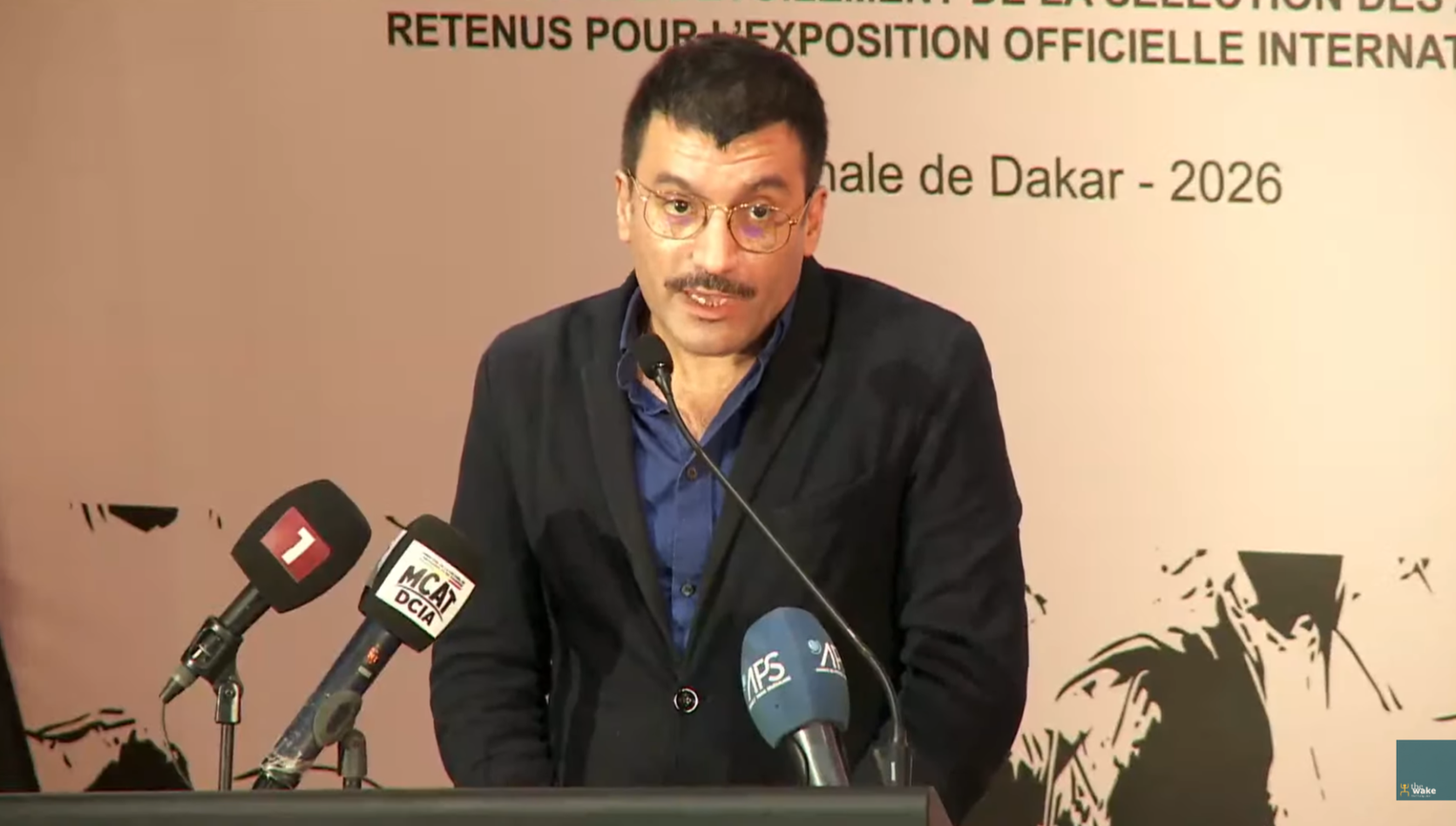
Morad Montazami lors de la Cérémonie annonçant la liste des artistes sélectionnés à la Biennale de Dakar 2026
In his introductory remarks, Artistic Director Morad Montazami described this edition as both historic and resolutely contemporary.
Framed around the concept of (Anti)Fragility, the curatorial proposal brings together artists from across the African continent and its diasporas to reflect on the ways we live together and coexist — with one another, but also with the living world.
How can we rethink these forms of coexistence in a world marked by multiple forms of fragility? The practices brought together for this edition explore strategies for creating refuge, forms of care and therapeutic approaches, as well as new ways of creating collectively.
(Anti)Fragility becomes less about denying vulnerability than about examining what can emerge from it: transforming fragility into strength through connection, transmission and co-creation.
This edition will also pay tribute to Koyo Kouoh, a major figure in African and international contemporary art.
Another new dimension of this edition is the inclusion of design, with a section led by Oulimata Gueye, Madeleine de Collenay, Delphine Lopez, Fatima Bintou Rassoul Sy and Youssouf Fofana, extending the curatorial conversation to the objects, uses and forms that shape the ways in which we inhabit the world.
The Democratic Republic of the Congo was also announced as the Guest of Honour of the Dakar Biennale. Described during the ceremony as a “continent-country,” the DRC was presented as embodying the notion of (Anti)Fragility through its resilience.
The status of artists and copyright were also highlighted as areas of continued development within Senegal’s cultural policy.
“To think and act for ourselves and by ourselves, as Black people [...], to embrace modernity without trampling on our authenticity.”
— Léopold Sédar Senghor
Beyond its artistic dimension, one of the broader ambitions expressed during the ceremony was the need for culture to move from being a showcase to becoming a genuine driver of economic and cultural development.
This direction forms part of a longer-term ambition: by 2050, to establish culture and the cultural and creative industries (CCIs) as genuine engines of growth, value creation and cultural influence.
ABOUT
(Anti)Fragility: Arts of Repair and Counter-Shock Strategies
For the 16th edition of the Dakar Biennale, the Steering Committee appointed Morad Montazami, Director of Zamân Books & Curating, as Artistic Director.
An art historian, publisher and exhibition curator, Montazami has been entrusted with developing an original curatorial project in dialogue with the specific mission and values of the Biennale of Contemporary African Art.
This edition is structured around the concept “(Anti)Fragility: Arts of Repair and Counter-Shock Strategies.”
For the Artistic Director, to be (anti)fragile is to adopt an approach that transforms fragility into a strength — both expressive and artistic — by placing social and communal bonds at the heart of the conversation, particularly through co-creation.
Information