Chéri Samba's Iconic Work Returns in Matongé’s streets on DR Congo Independance Day: When Contemporary Art Becomes Urban Heritage
An iconic work by Chéri Samba returns to Brussels on 30 June, the National Day of the Democratic Republic of the Congo. More than a year after being removed following a storm, Porte de Namur ! Porte de l'Amour ?—one of the most recognisable landmarks of Matongé—will once again take its place in the heart of Ixelles. The restoration of this monumental reproduction offers an opportunity to revisit the story of a contemporary artwork that has become part of the city's urban heritage.
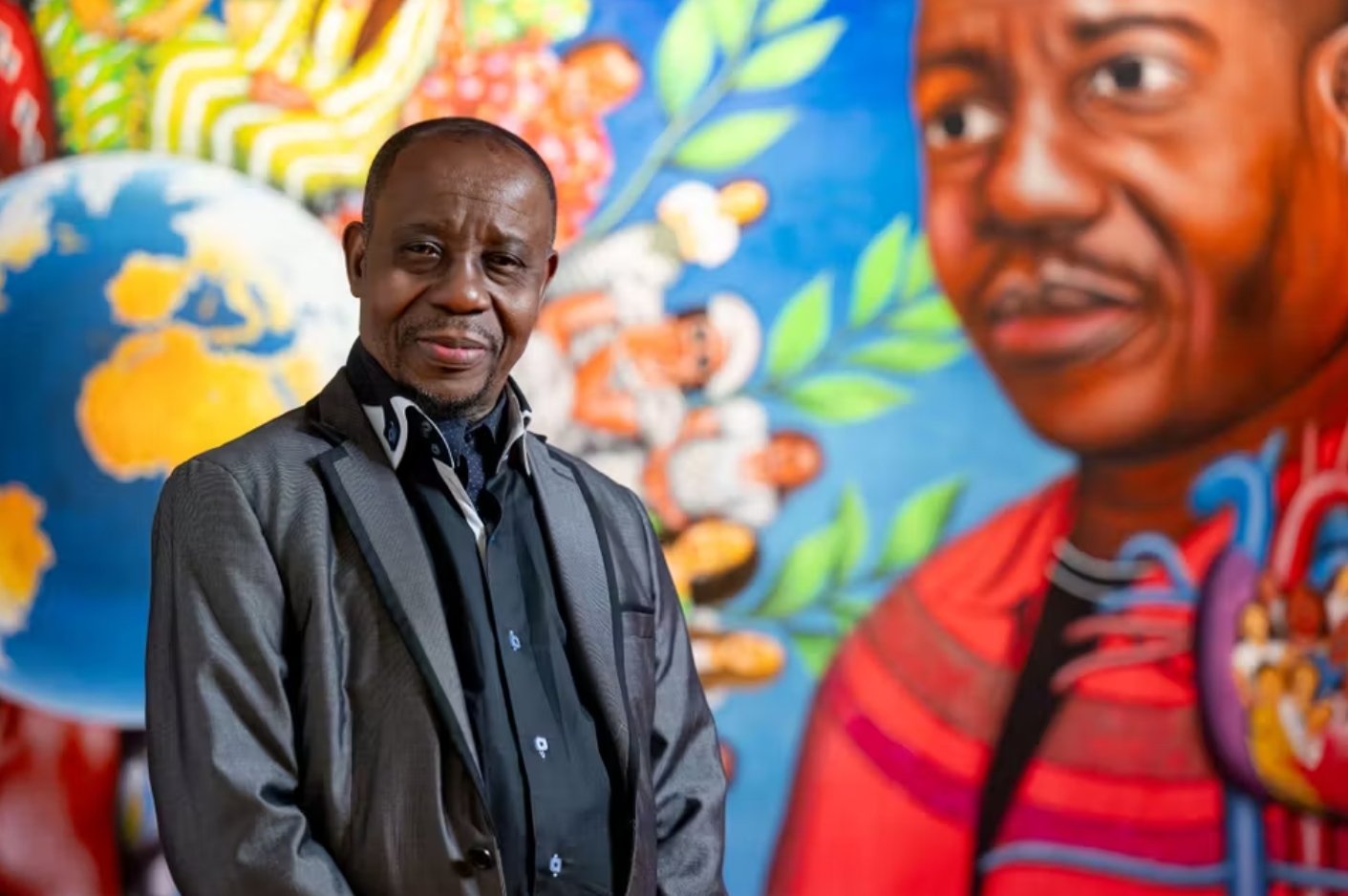
Chéri SAMBA, Credit : Nicolas LOBET
For many, it simply marks the return of a familiar landmark. Yet the reinstallation of Chéri Samba's Porte de Namur ! Porte de l'Amour ? tells a much broader story: that of an artist's residency, a neighbourhood that embraced an artwork as its own, and the way contemporary art can, over time, become part of a city's living heritage.
A Work Born with Matongé
Contrary to what one might expect, Porte de Namur ! Porte de l'Amour ? was not conceived in Chéri Samba's studio before arriving in Brussels. It emerged from Matongé itself.
Invited to Brussels in 2002 for a three-month residency, the Congolese artist spent weeks immersed in the neighbourhood—walking its streets, observing its residents, businesses and everyday rhythms—before developing several proposals. The work that now overlooks the Porte de Namur was the one ultimately selected.
"Chéri Samba came to Brussels for a three-month residency. He immersed himself in Matongé, spending weeks exploring the neighbourhood before developing several proposals. The work we know today was ultimately the one that was selected."
recalls Dominique GILLEROT, Director of NGO Coopération Éducation Culture. The work was subsequently reproduced on a monumental scale and installed above the Porte de Namur. Originally intended as a temporary installation, it would eventually remained installed for the next twenty-four years. Over the years, though it has moved façades, witnessed the transformation of the neighbourhood, it became part of the daily lives of several generations of Brussels residents. More than an image, it has become a landmark—a lasting presence of contemporary art in the public realm.
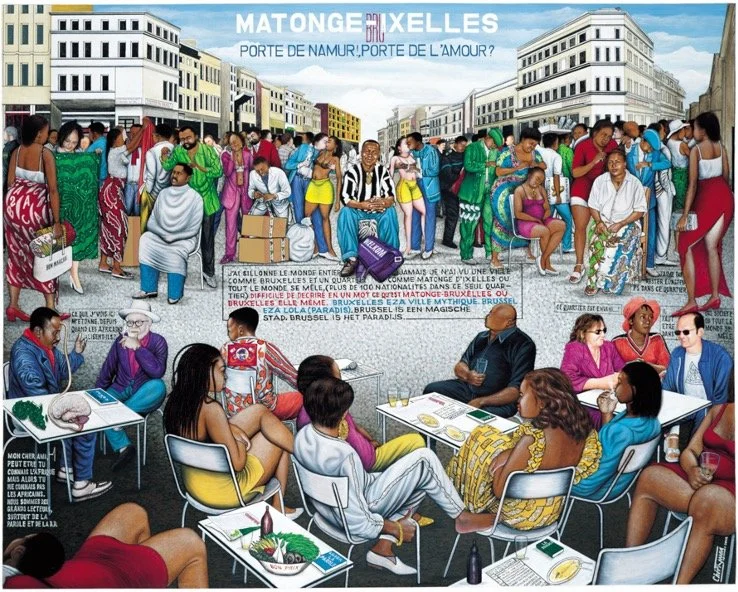
Porte de Namur ! Porte de l’Amour ?, Chéri SAMBA
When an Artwork Ceases to Belong Solely to Its Artist
What stands out in Dominique Gillerot's account is the way this work gradually transcended its artistic status to become part of both the heritage of the Congolese diaspora in Belgium and the history of the Municipality of Ixelles in Brussels. As she puts it, "This artwork is part of the landscape."
Her words capture the work's true significance. Heritage is not only what we preserve because it is old; it is also what we immediately notice when it disappears. That is precisely what this restoration reveals between the lines.
At the beginning of 2025, a violent windstorm tore away part of the banner, forcing its removal for safety reasons. Its absence revealed what it had become: an integral part of the everyday urban landscape.
The Municipality of Ixelles subsequently entrusted Coopération Éducation Culture (CEC) with overseeing its reprinting so that it could return to its rightful place.
"What the locals will discover tomorrow is not a new mural. It is a reproduction of the very same painting Chéri Samba created in 2002."
That distinction is essential. This is not about replacing an artwork; it is about preserving its presence. Every stage of the project has been carried out in close consultation with the artist.
"The entire history of this banner has always unfolded in direct collaboration with Chéri Samba. We contacted him to reassure him that his work would remain there and continue to live on."
CEC's Quiet but Pivotal Role
This restoration also tells a lesser-known institutional story.
Founded in 1977, Coopération Éducation Culture (CEC) was established to introduce African authors—then largely absent from Belgium's cultural landscape—to new audiences through the creation of a specialist library dedicated to African, Caribbean and diasporic literature. Over the decades, the organisation expanded its mission to the visual arts, while pioneering work on colonial representations, archives and the deconstruction of enduring stereotypes.
"We worked extensively to increase the visibility of African authors, who were still largely absent from Brussels' cultural landscape. At the same time, we developed a parallel body of work dedicated to deconstructing stereotypes and the imagery inherited from colonial propaganda."
Against this backdrop, the Chéri Samba project emerged as a natural extension of CEC's long-standing mission: to secure a lasting place for African artists within Europe's cultural landscape—not as occasional or symbolic presences, but as enduring contributors to the public realm, reflecting and engaging with broader societal shifts.
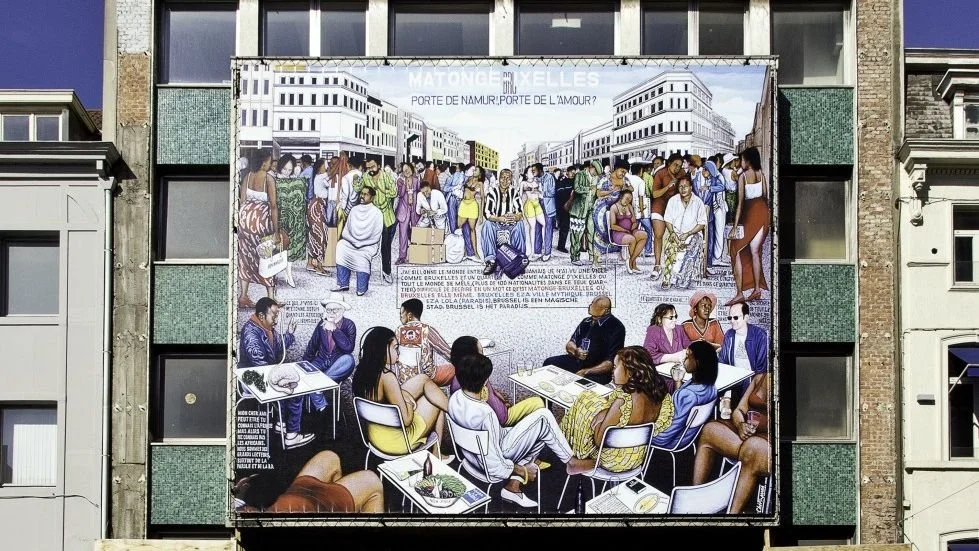
Porte de Namur ! Porte de l’Amour ?, Chéri SAMBA in the streets of Matongé
A Date That Carries More Than Symbolism
The choice of 30 June is, of course, no coincidence.
By unveiling the work on the National Day of the Democratic Republic of the Congo, the organisers reaffirm the deep historical ties between Matongé and the Congolese diaspora, while celebrating the place of African contemporary art within Brussels' cultural landscape.
The ceremony will bring together institutional partners, representatives of the Congolese Embassy and members of the artistic community. The programme includes a musical poetry performance by Badi, accompanied by percussionist Amine Kanzi, a gospel performance by the choir Voix de Mémoire featuring singer Amanda Malela, and concludes with a celebration of Congolese rumba.
Beyond Restoration
At first glance, this reinstallation may appear to be little more than a conservation project.
In reality, it tells a much deeper story. At a time when discussions around African heritage are largely centred on restitution and museum collections, the return of Chéri Samba's monumental work invites a different question:
How do we preserve the contemporary African artworks that are already shaping Europe's public spaces?
Heritage does not begin only when artists are gone. Sometimes, it begins when an artwork ceases to belong solely to its creator and becomes part of the identity of a neighbourhood.
In Matongé, Chéri Samba's monumental reproduction is no longer simply an artwork. It has become a landmark—a symbol watching over the Porte de Namur, one of Brussels' most significant gathering places for the Congolese diaspora.
Its return is a reminder that public art does more than tell the story of artists.
It quietly becomes part of the story of a city.