Kenyan Sculptor Gakunju Kaigwa returns with impressive Ancestral Grain and Speaks on Turning Fallen Trees into Functional Art
Curated By Tewasart And Patrons, Nairobi. Moderated By Alice Kamanzya
Kenyan sculptor Gakunju KAIGWA makes a return with Ancestral Grain, a solo exhibition featuring functional sculptures made from revived fallen trees. The established artist reflects on the sacredness of wood and the meaning of functional objects that surround us. Ancestral Grain on view at Village Market, Nairobi. Curated by Tewasart and Patrons until the 31 May 2026.
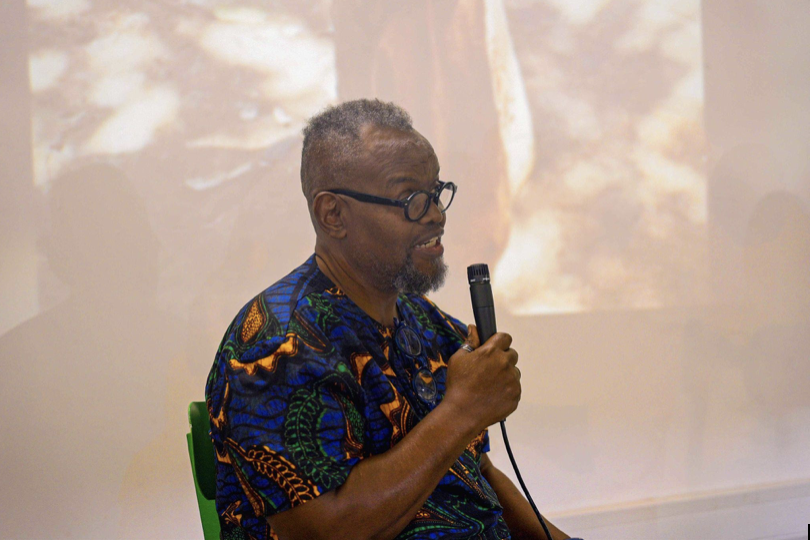
Image: Gakunju KAIGWA | Courtesy of Godwin Olusegun
Every grain of wood tells a story. In Ancestral Grain, Gakunju KAIGWA gives fallen trees a second life — one that honors their long memory and the unseen energy they still hold. These trees once stood rooted in the same soil that nourished generations. They have felt the wind that carried songs, the rain that blessed harvests, the footsteps and laughter of those who came before us. Like heirlooms of the earth, they carry the vibration of time — the quiet wisdom of endurance. In this conversation moderated by Alice KAMANZYA, Gakunju KAIGWA reflects on his affection towards woods, and philosophy in turning fallen trees into functional sculptures full of life.
Each sculpture in Ancestral Grain is a vessel of continuity — where nature, ancestry, and artistry intertwine. In every polished surface and living curve, we are reminded: The tree never truly dies. It simply changes form — carrying the breath of our ancestors into the spaces where we live, sit, and dream. On 02 May Tewasart and Patrons hosted an artist talk with Gakunju Kaigwa at Village Market moderated by Kenyan artist Alice Kamanzya.
Alice KAMANZYA : Forty-five years of experience in sculpting is an incredible journey of knowledge, discipline, and artistic evolution. What inspired your solo exhibition Ancestral Grain, and what story were you hoping to convey through the works?
Gakunju KAIGWA : Functional sculpture has been an ongoing project for me, an idea that has developed gradually over time. For many years, I created conventional sculptures, mostly figurative works. I found myself constantly drawing figures from different sources — magazines, observations, or random ideas. I still have sketches dating back to 1983. I would make small drawings and always date them. About ten years ago, I realised I had accumulated a large collection of sketches and began exploring how to transform them into something tangible. Many of the sketches were quite old, and I had to interpret and reimagine the blurry lines into real forms. Around the same time, I was also thinking deeply about the three-legged stool as an object of everyday function and cultural memory.
I remember, as children, seeing stools decorated with Maasai beads, yet today they are increasingly difficult to find. I found that loss quite sad, and I felt compelled to revive that warmth, familiarity, and emotional connection. My aim was to reinterpret the form in a way that remained functional while introducing an authentic contemporary design that still carries those memories. I began with small and simple stools, then gradually expanded into larger chairs, tables, and benches. It has remained an evolving and ongoing body of work.
Alice KAMANZYA : Ancestral Grain is happening 28 years after your last solo exhibition. Why did you take such a long break before presenting another solo show?
Gakunju KAIGWA : This is not my first time exhibiting functional sculpture, the first time I exhibited such works was in 2015, in a shared exhibition with a fellow artist and painter. Most of his paintings were displayed on the walls, while I occupied the floor space with the sculptures. That experience encouraged me to continue pursuing this direction within my practice.
Part of the reason is that I became deeply involved in teaching and spent 12 years as an art educator at the International School of Kenya, which became a significant turning point in my life and career. I retired from teaching in 2024 at the age of 65, after my contract came to an end. I could have continued teaching, but I felt it was important to create space for a younger generation. At the same time, it also felt like the right moment to fully return to my studio practice and explore new possibilities.
Stepping away from teaching gave me the opportunity to reflect on what I wanted to focus on at this stage of my artistic journey. I decided to dedicate myself fully to redefining my practice and developing ideas I had carried with me for many years. When I returned to the art scene, many people were excited to see the new projects I could finally devote my time and energy to. Sculpture ideas also take time to develop into a complete body of work. Sometimes works remain in the studio for long periods while I continue refining them, and at other times commissions can be quite demanding and time-consuming. A lot can happen that limits the time needed to prepare for a solo exhibition. To present a strong solo show, you need both time and a substantial body of work.
Personally, I enjoy exploring ideas in series. Ancestral Grain, for example, focuses on functional sculpture and explores wood deeply as a medium. The works in this exhibition took nearly two years to create.
“Functional sculpture has been an ongoing project for me, an idea that has developed gradually over time.”
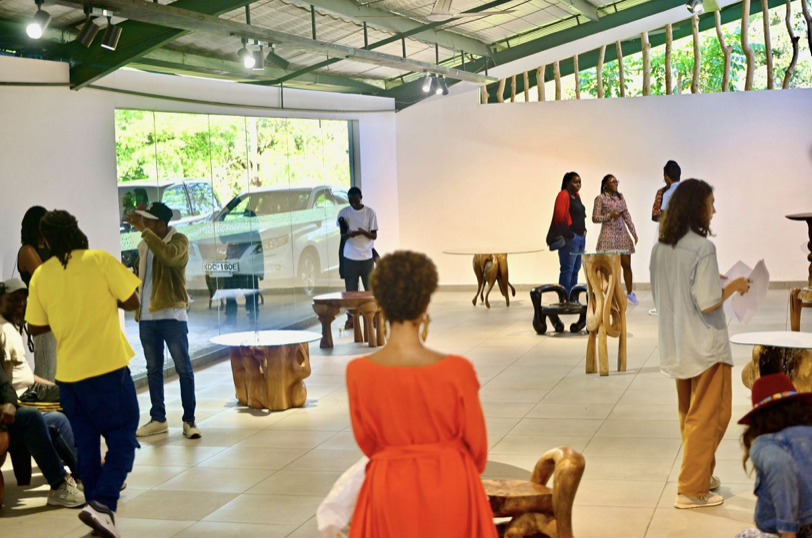
Ancestral Grain Opening Reception | Image courtesy of Godwin Olusegun
Alice KAMANZYA : Discuss your journey working with wood as your primary medium in Ancestral Grain.
Gakunju KAIGWA : I worked with a variety of woods in this exhibition, including Kijabe, oak, mango, eucalyptus, podo, palm wood, cypress, cedar, mahogany, and jacaranda. The log itself is a very important part of the tree, and almost every piece in this exhibition — except one — began as a single log. I essentially extracted what I needed from the tree until I arrived at the desired form.
What is quite remarkable is that, apart from the two tables Menengai and Mugumo, most of the works were created from a single piece of wood. Those two tables combine up to three different types of wood, which made the process more complex, since many functional pieces often require joining two or three separate sections together.
I chose to focus on wood because of its unique character and warmth. Of course, functional sculpture can also be created using metal or stone, but wood carries a certain intimacy. When you touch it, you immediately feel its warmth and presence through your hands. It is inviting and alive in a way that other materials sometimes are not. That is why I always encourage people to sit on the chairs, touch the works, and interact with them freely. I tell them to enjoy the experience because that is the essence of functional sculpture.
Creating functional sculptures is deeply exciting for me, and this body of work is only part of an ongoing exploration. I am currently developing a new project intertwined with ideas around femininity, which I find very exciting, and I believe it will open up another interesting direction in my practice.
“ When you touch it, you immediately feel its warmth and presence through your hands. It is inviting and alive in a way that other materials sometimes are not. That is why I always encourage people to sit on the chairs, touch the works, and interact with them freely. ”
Audience: I’ve watched you work and noticed how deeply absorbed you become in the process, almost as if you drift into another space. You’ve also mentioned that when you finish a piece, you are sometimes surprised by the result yourself. Can you tell us more about your journey as an artist and what usually goes through your mind while creating?
Gakunju KAIGWA : I think there is a certain element that most creatives possess. When you make art, you become a custodian of the work. It is a privilege to take an idea — something invisible and imagined — and bring it into physical form. Being creative is both a gift and a talent, and once you realize you have it, you must decide what to do with it.
For me, there is something magical about the process. Sometimes it even feels surreal. When I reflect on it more deeply, I realize how powerful creation can be — starting with a log or a random piece of wood and transforming it into something meaningful and beautiful. In many ways, the process feels bigger than me. I simply allow the creative energy to flow and try not to resist it.
By the end of a project, I often feel both happy and surprised by what has emerged. Creating in this way also requires a great deal of humility, which I believe is an important virtue for any artist. What I enjoy most is experiencing the entire journey of the work — from the first gesture or idea to the final piece. The process itself is deeply fulfilling, and the feeling never really loses its sense of wonder.
Audience: I am a forester, and I am curious about your contribution toward forest conservation, considering that most of your work relies on wood from cut trees.
Gakunju KAIGWA : That is a very important question. Over the years, I have built strong relationships with professional woodcutters along Limuru Road who mainly clear trees from construction sites or remove trees that have fallen during storms. I have never gone into a forest to select and cut down trees specifically for my work. Instead, we have an understanding where they contact me whenever they have available logs that might be suitable for sculpture.
I often work with eucalyptus, which is not an indigenous species. It is a hardwood with very clean edges when cut, allowing me to achieve some of the sharper and more refined forms you may notice in the works.
I also come from a family that deeply values trees and conservation. My late brother was especially passionate about tree planting and forest conservation, and he had a significant influence on my thinking. I personally enjoy living in places surrounded by trees or close to forests, and tree planting has always been part of my life. Over the years, I have planted countless trees myself and strongly believe in the importance of protecting our natural environment.
In many cases, the wood I use would otherwise have been discarded or turned into charcoal. By transforming these logs into sculptures and functional objects, I feel I am extending the life of the tree in another meaningful form — one that continues to exist and serves a purpose in daily life. So conservation is something I remain very conscious of, both in my practice and in my personal life.
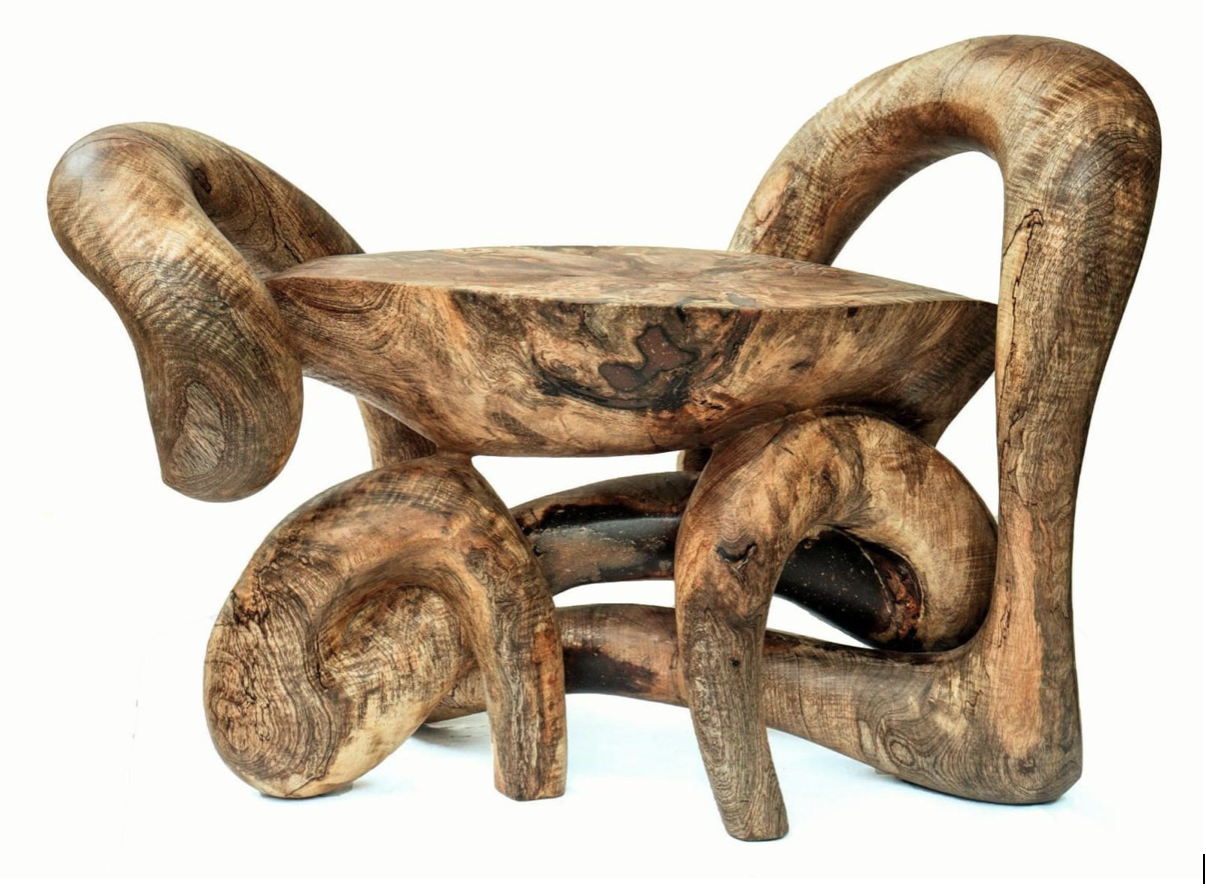
Olenguruone, 2025, Mango Wood | Courtesy of the Artist
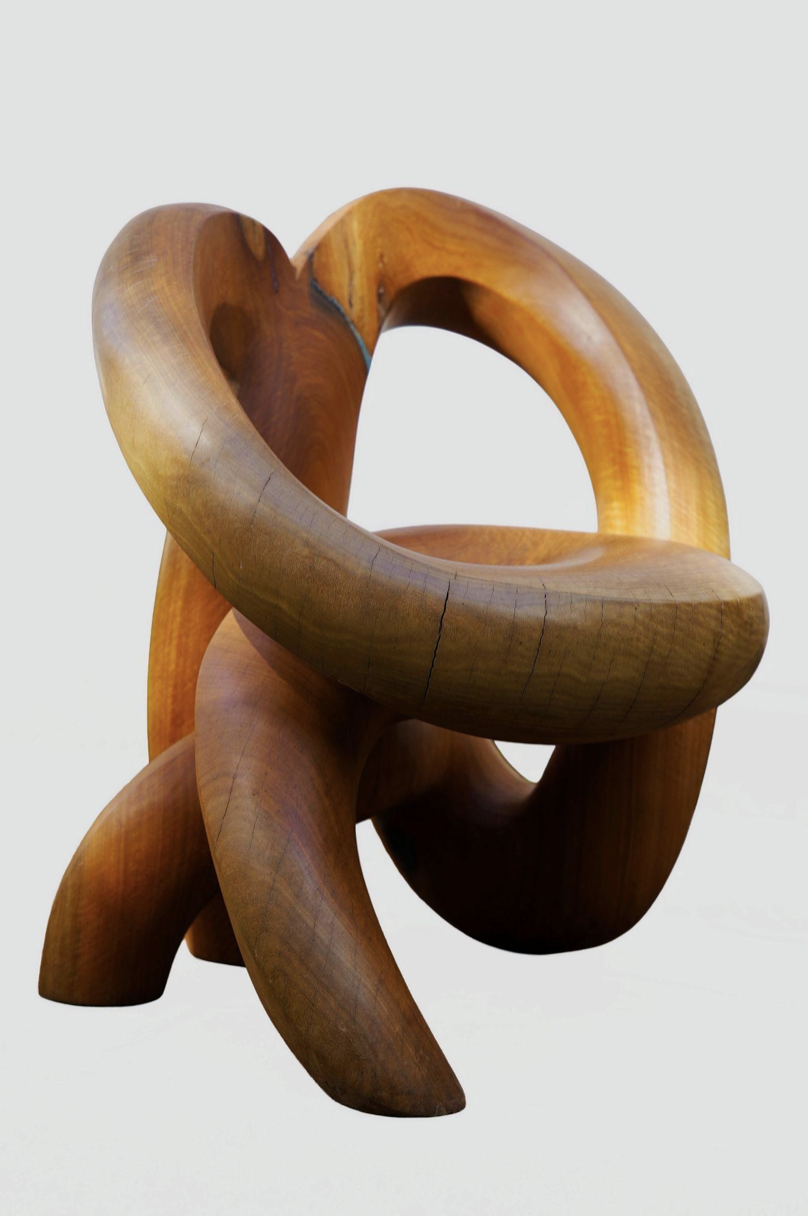
Kijabe, Eucalyptus Wood, Courtesy of the Artist
Audience: How did you end up in Academia, did it have any impact on you?
Gakunju KAIGWA : Initially, I had no plans to go into teaching at all. A friend of mine introduced me as a substitute teacher while she attended to some medical challenges that required her to be away for quite some time. I stepped in temporarily, but her recovery period became longer than expected, and eventually I was asked to take over as the main art teacher. Before I knew it, I had spent 12 years teaching without ever really planning for it.
Teaching was deeply satisfying because it allowed me to share knowledge, especially with young learners. At the same time, teaching also teaches you a lot. The students were incredibly sharp and ambitious, always coming up with interesting projects and backed by strong research and resources. It became a major turning point in my life. Sometimes you simply dive into something and grow through the process.
Some of the students later pursued further studies in art and eventually returned with inspiring success stories, which gave me a real sense of pride in knowing I had played a part in their journey. Teaching can demand a great deal of energy, but in the end, it is incredibly rewarding.
During that period, however, I spent less time in my studio and focused more on teaching. There are projects, like a chess set I have been developing for quite some time, that I still hope to complete soon. I was not always able to fully focus on my own practice because other responsibilities kept emerging. There was also a certain comfort that came with having a steady paycheck, which in some ways slowed the trajectory of my career and reduced my visibility within the art scene.
Now that I am back in the studio, I feel able to finally pursue many of the plans and ideas I had carried with me over the years. I also feel a strong sense of urgency to make up for the 12-year hiatus. At the same time, teaching taught me valuable lessons — especially discipline and timekeeping — and I remain grateful for everything I learned while working with the younger generation.
“For me, it does not have to be one or the other. Personal success and the positive impact you have on others can exist together, and both are equally important and deeply rewarding.”
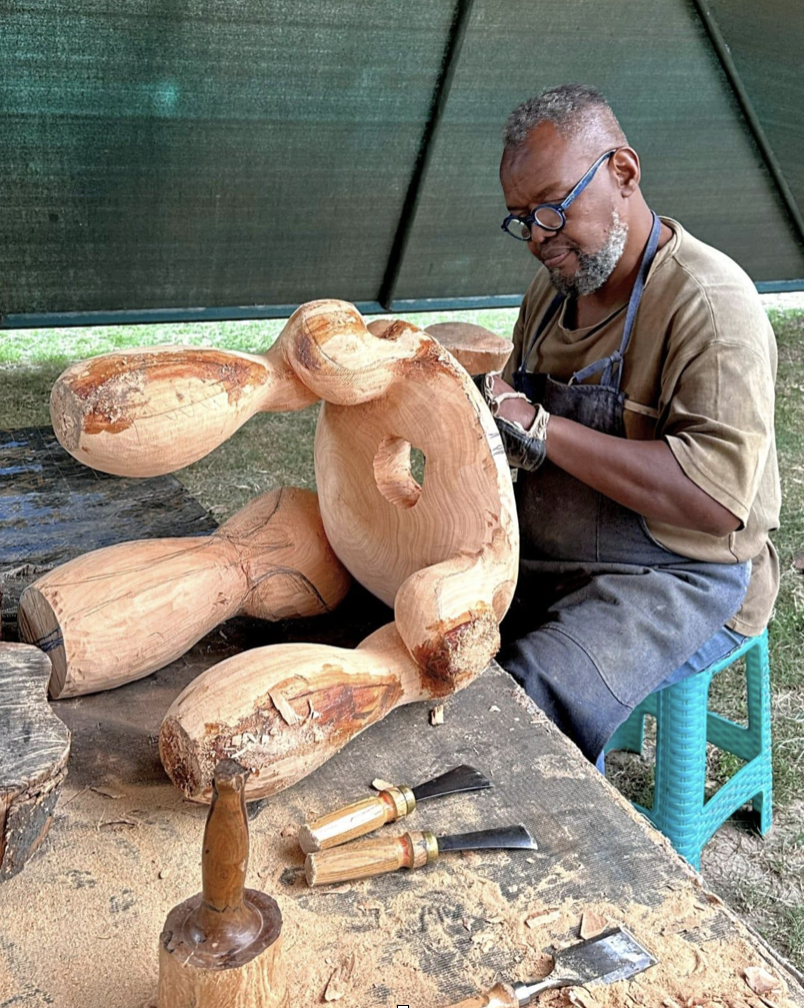
In studio - Gakunju Kaigwa | Courtesy of the Artist
Audience: Over the past 45 years, what do you celebrate more — your personal success, or the impact and significance you have had in the lives of other people?
Gakunju KAIGWA : Both aspects bring me great happiness. I take pride in the work I create, and I always hope that people can connect and resonate with it. Any successful artwork communicates with people on a deeper level.
What I find especially fulfilling about teaching and mentorship is the moment when you introduce someone to an idea or skill they had never encountered before, and guide them through the process of understanding it. Helping people expand their perspective, elevate their thinking, and see the world differently is something very meaningful to me. It is a privilege — one of the purest and most authentic forms of beauty.
My close friend, the late Patrick MUKABI, spent many years in the industry and dedicated so much of his life to supporting and guiding younger artists through their journeys. He made an extraordinary impact on many people and will always be remembered for that generosity and dedication. For me, it does not have to be one or the other. Personal success and the positive impact you have on others can exist together, and both are equally important and deeply rewarding.
Audience: Do you have any plans to create mentorship opportunities to share your vast knowledge and experience in sculpture with young artists in your community, beyond the time you have dedicated to teaching practice?
Gakunju KAIGWA : People often ask me, since I have already worked as a teacher, whether I would consider establishing an art institution or creating more structured opportunities to teach art. I have always maintained an open-door policy in my practice, welcoming anyone interested in learning about art and sculpture — both children and adults.
I personally benefited greatly from an apprenticeship I undertook for about four months with one of my mentors. The late John Oduoch saw my work in a gallery and invited me to collaborate with him on a project at African Heritage. Looking back, the skills and techniques I learned under his guidance had a tremendous impact on my artistic journey. Not only did my style evolve, but my way of thinking and creative process also changed significantly. He even taught me how to weld. That hands-on approach to learning is often one of the most effective ways to truly understand a craft.
Today, I work from my studio space at Kuona Artist Collective in Kilimani, where we host more than 30 artists working across different disciplines, from leatherwork and jewellery to sculpture. We also receive many visits from children, schools, and university students who come to explore the space and learn different creative skills. Institutions such as BuruBuru Institute of Fine Arts continue to play an important role in nurturing young talent, and I would also like to acknowledge Kenyatta University for their consistent efforts in supporting students and fostering creativity. Many students go through a two-month apprenticeship, and by the end of the program, their growth and improvement are remarkable.
There is a great deal of talent out there, and a lot of positive creative activity happening. Now that I am less occupied with school commitments, I feel I have more time to seriously think about creating short workshops, mentorship initiatives, or community-based art programs that can help nurture the next generation of artists.
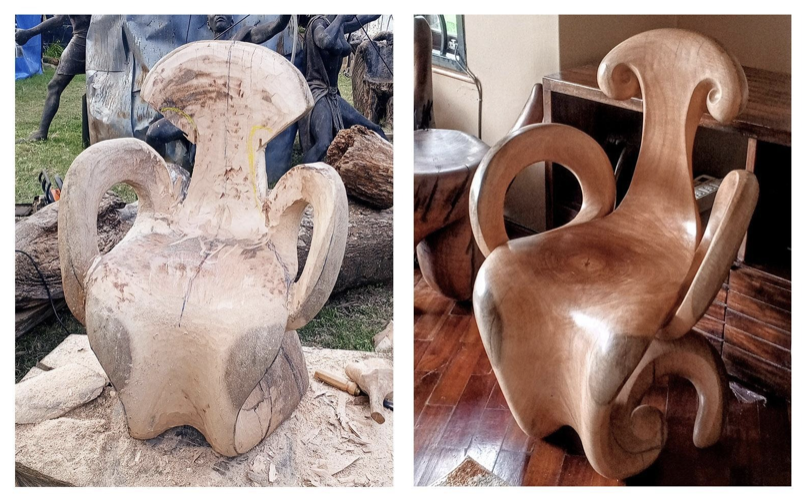
Elementaita, Eucalyptus Wood, 2025, Courtesy of Artist
Find the work of Gakunju KAIGWA in Ancestral Grain curated by Tewasart And Patrons and on his personal spaces.