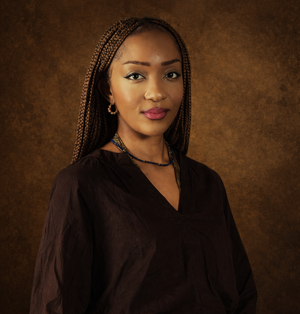
Organic Maps and Talismans: A Conversation with Tiffanie DELUNE
Tiffanie DELUNE’s art (b. 1988) immerses us within an organic, branching structure rooted in her personal memories, as well as in the ancestral memory of her lineage, which she explores with remarkable subtlety. From canvas to textile, her world is imbued with a sense of magic, unfolding as we trace the thread of her artistic journey, shaped by key encounters and places, and above all, by a profound faith in the inner forces and intuitions that guide us, if we choose to listen closely.
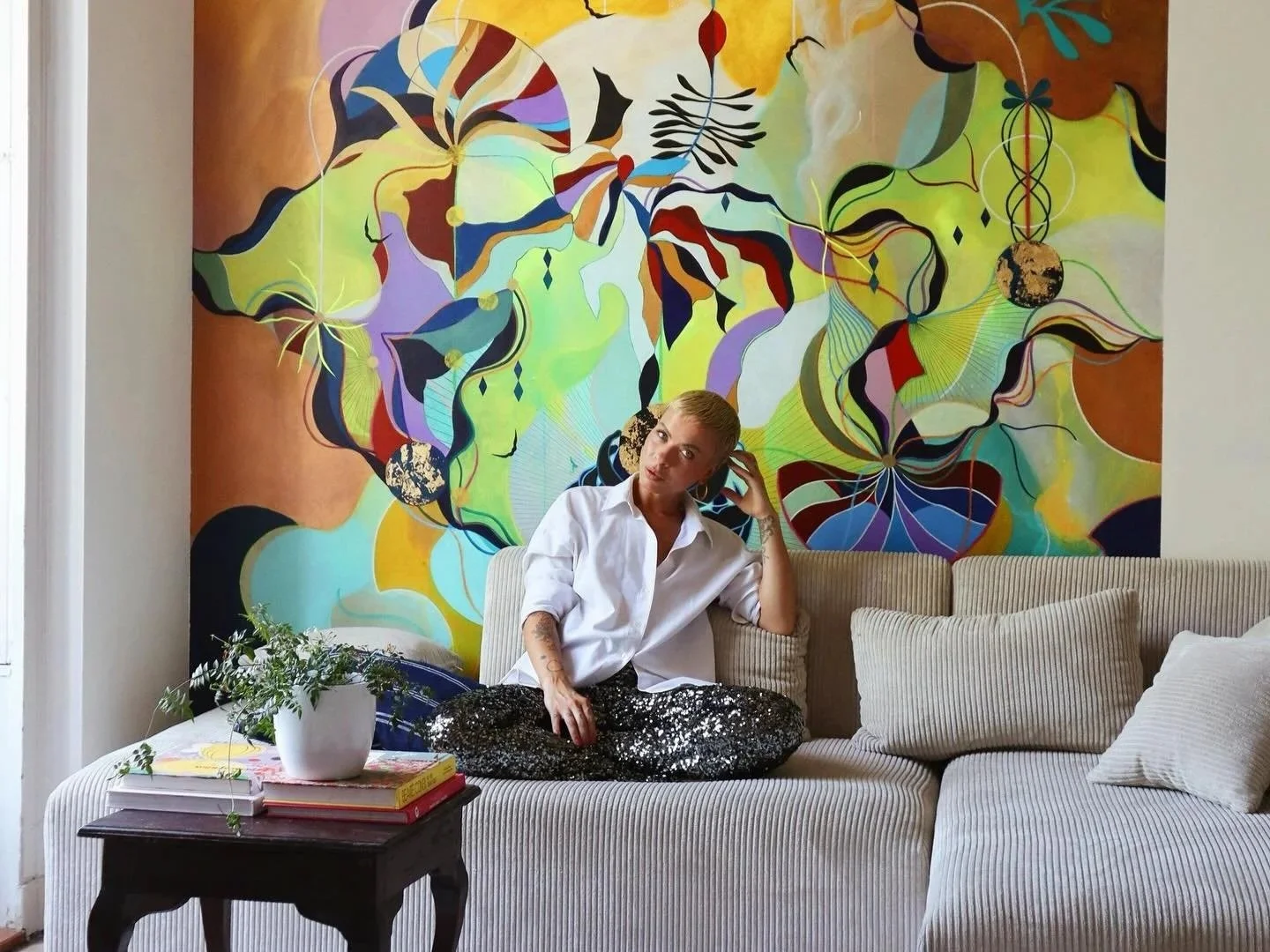
Tiffanie DELUNE
We meet Tiffanie DELUNE during the opening of Mouvements Sacrés (Sacred Movements) at Galerie Christophe Person in Brussels. Of Franco-Congolese-Belgian heritage, she grew up in the Paris suburbs, her mind shaped by the influences of her surroundings and a keen sensitivity to beauty. Yet, rather than turning her origins into a visual identity motif, she transforms them into a space for reflection. In this exclusive interview, we explore the journey of an artist seemingly guided by an invisible grace—a common thread shaping her work with both authenticity and maturity.
Ngalula MAFWATA : How would you define your relationship with art?
Tiffanie DELUNE : Creativity has always been an innate passion for me. I have always been drawn to art, fashion, and design. Yet, in my late teens, I kind of discouraged myself, thinking it was an uncertain path—especially in the 1990s, when there were hardly any living artist role models making a career from their work, outside of those from certain schools already integrated into established networks—not to mention women. I quickly became aware of this reality, which led me to spend ten years in advertising, working as a project manager and in photographic production. I was born and raised in the Paris region, which I left at 18 to live successively in Montreal, Geneva, and then back to Paris over the following decade.
Ngalula MAFWATA : During that decade, was art still part of your daily life?
Tiffanie DELUNE : My creative side has always manifested by me being drawn to imagery and the pursuit of beauty. My professional journey ultimately served as school, evolving in an international environment and in contact with many people. You could say I was creating informally, whether in photography or painting, but it wasn’t a fully realized practice or a deliberate project. At no point did I think it was possible to pursue it seriously. I was never in a position to plan or structure anything, and above all, I knew absolutely nothing about the art world. I had no idea how it worked, how to exhibit in a gallery, or even what art implied in public spaces.
Ngalula MAFWATA : Was there a pivotal moment in your life when started considering it more seriously ?
Tiffanie DELUNE : When I was 29, I moved to London, driven by an inner call. Without being able to explain it, I’ve always been attentive to my intuitions, as if connected to something larger. This time, it was a visceral, feminine instinct whispering to me: I have to go for it. London has always had a special quality for me—whenever I was there, I felt free, accepted, fully alive. I felt as if I could finally breathe, rather than closing in on myself. Once settled, things moved fairly quickly. By chance, I ended up living near Adébayo BOLAJI and watching him paint. Observing his gestures, his focus, and his creative freedom awakened something within me.
My pregnancy also plunged me into deep reflection. The birth of my son acted as a catalyst. From that moment, a sense of urgency took hold of me, one I could no longer silence or ignore without risking my well-being. It is a unique feeling that lets you know you could live differently, do something else, and above all, finally listen to yourself.
Ngalula MAFWATA : What did your first paintings look like, and what messages did they carry ?
Tiffanie DELUNE : I started in my kitchen, without really knowing what I was doing. [laughs] From the very beginning, color played a central role, alongside a form of abstraction and recurring motifs such as birds and circles. There was already a connection to nature, though not necessarily in a representational way. I quickly realized that I am not a painter in the conventional sense—neither in my thinking nor in my approach. I am more drawn to exploration, working with materiality and emotion. I soon began incorporating other elements: paper cutouts, thread, glitter, spray paint, pastels. These comforting materials evoke my childhood and a sense of femininity, while thread and textiles carry a story, a message. The act of creating something tactile excites and stimulates me far more than painting in the traditional sense.
“Je ne suis pas peintre dans ma manière de penser ni dans ma recherche : ce qui m’intéresse, c’est d’explorer et de toucher à davantage de matérialité et l’émotion. ”
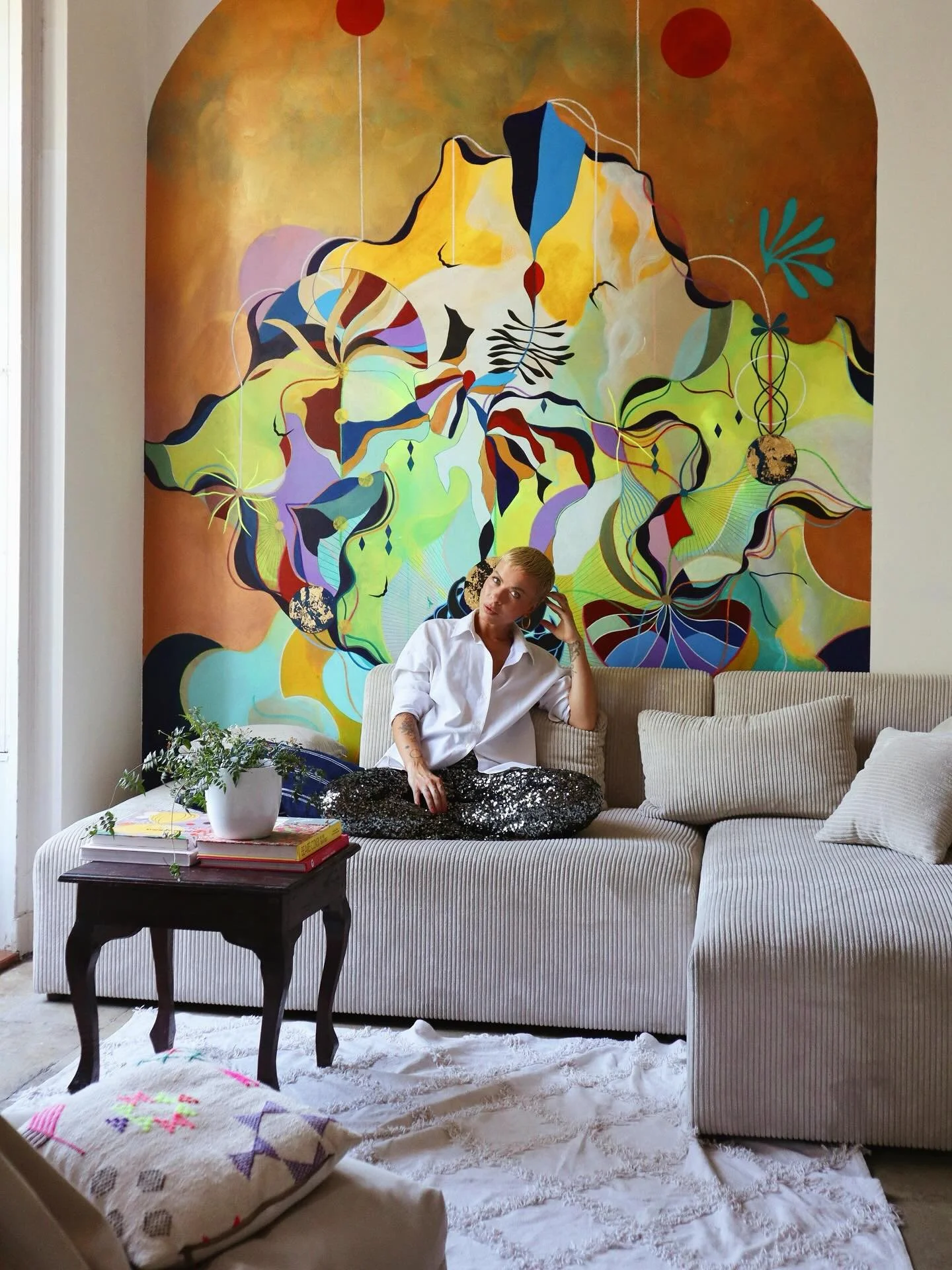
Tiffanie DELUNE; Crédits : Tiffanie Delune
Ngalula MAFWATA : How did your entry into the professional art world begin?
Tiffanie DELUNE: I was first noticed by Ed Cross (Ed Cross Fine Arts), who, over the course of our conversations, guided and challenged me. Rightfully so, he told me to keep pushing, because it was clear there was something there, though my work was still on the edge of being purely decorative. I love color, birds, and circles, but if you’re not careful, it can easily slip into a form of classic, almost decorative representation. I received this feedback with openness, knowing that one can never claim to know everything. It’s essential to stay receptive to critique. An external perspective is crucial, especially in the early stages when you don’t yet have enough distance from your work. Constructive exchanges with professionals—gallerists, art advisors, fellow artists—are incredibly nourishing. That doesn’t mean you should follow everything, but it’s about listening, reflecting, and deciding what to keep. Ed also taught me how to talk about my practice and write my artist statements, emphasizing the importance of understanding what you’re conveying, why, and who inspires you.
Ngalula MAFWATA : When did you dare to bring your personal story into your work, and what did that evoke in you?
Tiffanie DELUNE: Ed Cross was the first to tell me that I had depth, a story to tell, and that I shouldn’t hesitate to put all of that into my work to create new dialogues. It was at this precise moment in the process that I became more vulnerable—feeling almost exposed—but at the same time, it was profoundly liberating. I began to tell my own stories, almost like keeping a personal diary. The process proved therapeutic. In creating, I sometimes sought to understand my story, my place as a woman, and my origins through family narratives. When I started working in this way, I experienced a profound sense of liberation. Yet, when it came time to show these more developed works for the first time, fear would overwhelm me. For example, when I unveiled My Mother: a Cannibal Flower (2018)—a title that is quite evocative—I was literally paralyzed.
Ngalula MAFWATA : How was your work received in the early days?
Tiffanie DELUNE : I attribute part of my journey to good fortune, as my work was quickly well received and understood. In 2019, I exhibited for the first time at 1-54 in London. I had no expectations—at that point, I was still working full-time. Yet it was an immediate success. My breakthrough comes at an interesting moment where both on the African continent and in the diaspora, abstraction is present yet figurative work still prevails. I also come with a feminine perspective at a time when there was a growing awareness of the need for more women in the market, simply because there weren’t enough. This was also a period when textiles and all things craft-related were returning to prominence. The focus was shifting more toward emotions than mere commercial appeal. At that time, I was already presenting works on paper. I’m not sure if paper was yet widely recognized as a serious medium, but these pieces involved sewing, collage, and other fairly developed techniques.
Perhaps I arrived at the right moment with my practice. Around the same time, the art world also began questioning the representativeness of artists in the market: why only men, of a certain age, from certain schools? Many conventions were being challenged then—and continue to be.
Ngalula MAFWATA : The notion of femininity irrigates your work. Being a female artist, does that influence your thinking?
Tiffanie DELUNE : I don’t consciously dwell on it, yet I recognize that my art can carry a feminine dimension in forms, materials, movements, and attention to detail. That said, I don’t want to fall into limiting reasoning. A man can explore forms and materials with just as much subtlety, especially since each of us carries both masculine and feminine energies depending on circumstances and seasons. In fact, some of my works lean more toward the masculine, others more toward the feminine. My practice is introspective and reflects my lived experience at the moment of creation. I’m not sure if I consciously make the connection, but the interconnectivity between nature, inner work, and introspective moments naturally emerges in my practice.
“The art world feels like another world within the world, yet it is indispensable. ”
Ngalula MAFWATA : A tree-like structure seems to take shape within your art as a way of expressing your thoughts. What words would you use to describe it?
Tiffanie DELUNE: I define my abstraction as morphe. I’m drawn to fluid, curved forms that seem to dance. Even when I work with geometry, it is never perfect or dictated by the strict rules of sacred geometry. Unsurprisingly, I am fascinated by the natural world, constellations, astrology, magic, and tarot, exploring the connections between the body, anatomy, and patterns in nature—much like Georgia O’Keeffe did before me. I call these inner maps; they unfold across two dimensions: the physical journey—shaped by my own travels and my mixed-race roots—and the spiritual journey, a quest for self-understanding. The latter creates a vast, infinite world without tangible physicality: it is about representing the invisible, the intangible. My work is always evolving; I don’t consider it finished, nor do I believe it will ever be.
Ngalula MAFWATA : Is there a timeless quality in your work?
Tiffanie DELUNE: The spiritual quest is, by nature, timeless. It revolves around questions as old as humanity itself, recurring across cultures. Regardless of terminology, certain themes constantly emerge: for instance, light—does it come from within or from outside? What is its source? Through this inquiry, we attempt to understand the world around us, the universe, how to navigate our familial and ancestral heritage, and, most importantly, how to transform it. I call it a journey, in the sense that one should never lose curiosity or hope—the hope of knowing oneself, both individually and collectively.
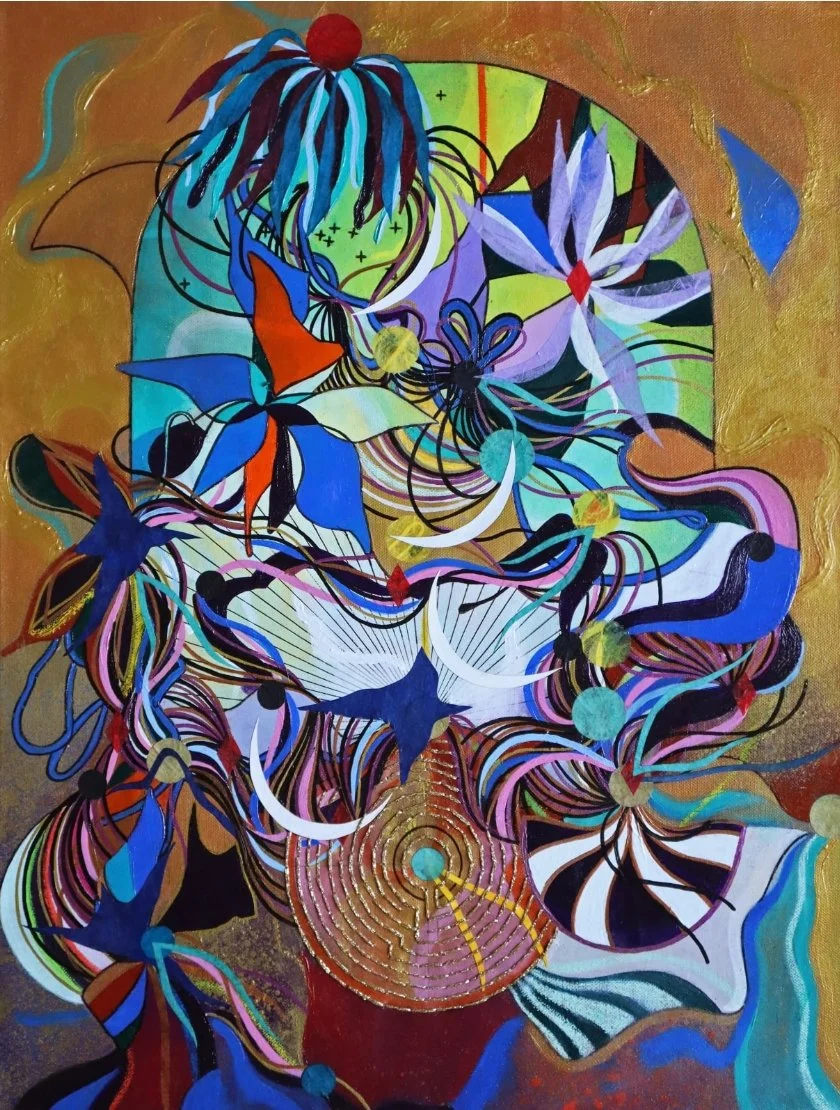
Labyrinths and Stitches , Techniques mixtes sur toile, 65 x 50 cm, Tiffanie DELUNE (2025)
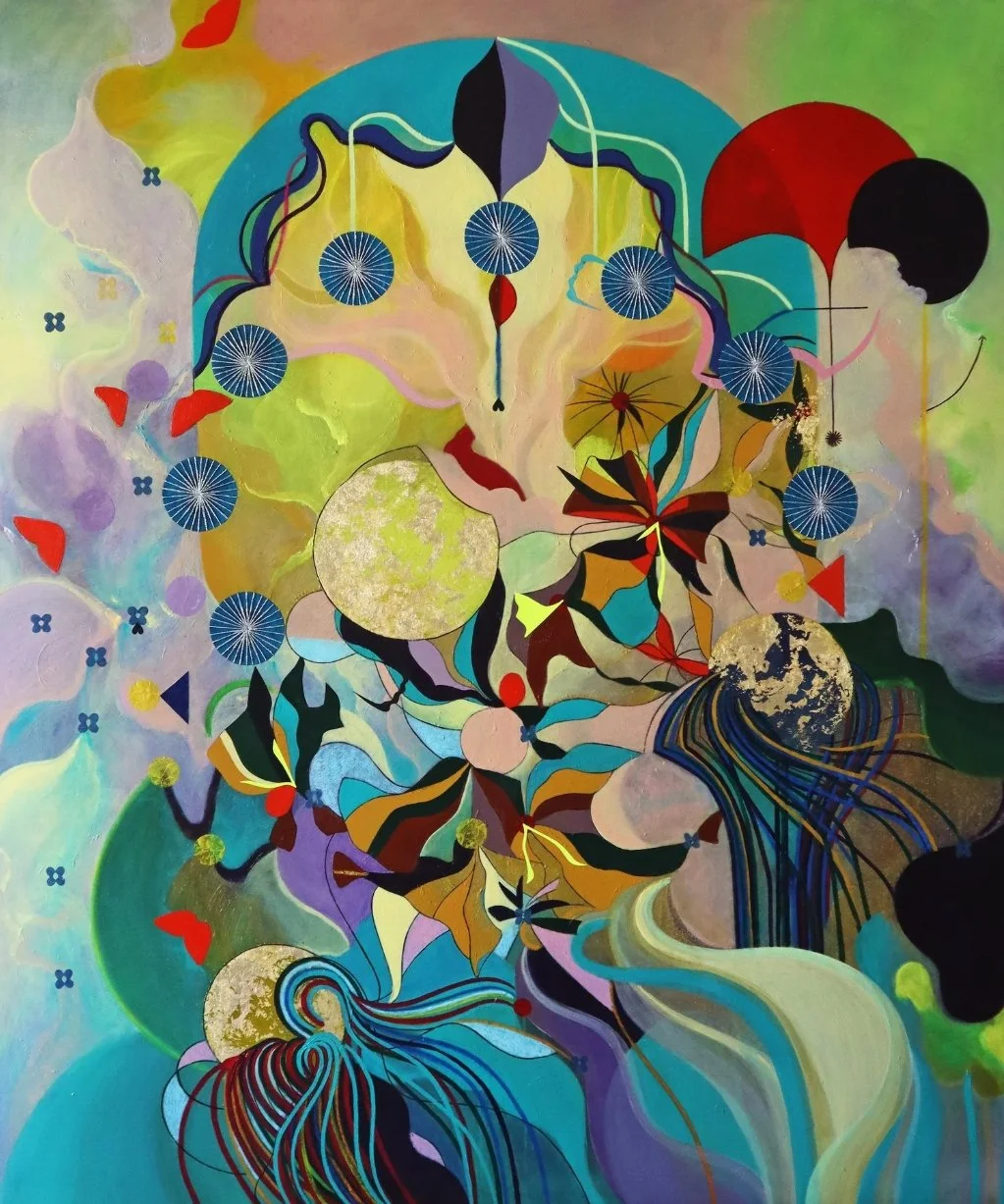
And The Sea Remembers..., Technique mixte sur coton, 180×150, Tiffanie DELUNE (2025)
Ngalula MAFWATA : Unconsciously, you trace the thread of your origins. Does this continue to inform your creative work?
Tiffanie DELUNE : Born into a multicultural family with a wide spectrum of origins, I grew up in an environment where every conversation - whether with siblings or parents - could be approached from a different perspective. This habit of seeing the world through multiple lenses nourishes my work. This hybridity is reflected in my ability to blend materials in a way that appears effortless. I am careful, however, never to fall into patchwork or a chaotic mix: as soon as I feel I’m overdoing it, I remove elements. My goal is to achieve fluidity and balance, much like a hybrid being. Even my choice of colors teaches me to observe the world with nuance rather than in extremes.
Ngalula MAFWATA : What have you learned since fully immersing yourself in art?
Tiffanie DELUNE : Being an artist is a life decision, and it influences everything else, from our political, economic, and social world views, as well as our ability to remain open and be surprised by life and people. It has taught me about life, particularly through residencies that allowed me to travel—sometimes far from my origins—and meet people from different cultures. The art world feels like another world within the world, yet it is indispensable. One cannot live without art—whether visual, music, or dance. Art has allowed me to heal and celebrate my inner child. Perhaps this is what we romanticize about the artist: that childlike spirit combined with adult maturity, allowing them simply to exist. There’s a sense of flight, of being different, of breaking routines, boxes, and codes. Today, the image of the “cursed” or suffering artist almost belongs to the past. We exist within life structures, yes, but we remain free—perhaps among the freest representations of what is possible.
“I grew up in an environment where every conversation - whether with siblings or parents - could be approached from a different perspective. This habit of seeing the world through multiple lenses nourishes my work. This hybridity is reflected in my ability to blend materials in a way that appears effortless. ”
Ngalula MAFWATA : There’s something of a life path in this journey. What motivates you to continue creating despite doubts and challenges?
Tiffanie DELUNE : Absolutely. You have to persevere, dance with the seasons, and continually return to the “why”: why we are artists and what we wish to convey. Refusing repetition and confinement to a single form of expression, I carry within me an endless curiosity—nurturing and sometimes demanding. We have only one life in this form on Earth, so we might as well make it meaningful. I love this dance of life. I take nothing for granted and know that everything could end tomorrow, but I would never regret having acted—and I would always have struggled to live with not having done it. One never truly stops being an artist; perhaps only the form, the way of presenting, or the people with whom one collaborates change. The ways of exhibiting, creating, teaching… all of this is part of the same path.
It’s this idea of infinite temporality, which isn’t confined to the conventional human experience. As an artist, one sometimes forgets their age. I don’t think I’ll ever stop, because once you allow yourself to create, stopping becomes impossible. Even in moments of doubt, the universe always finds a way to remind me that it’s not an option: I’m already on the path. [laughs] It reminds me a lot of The Alchemist: believing that you are guided by your star, by invisible forces, that moments of challenge exist to help you grow, to give depth. And ultimately, realizing that there is no final destination—everything about the journey itself is magical.
Find the work of Tiffanie DELUNE in conversation with Philippe SENE’s in Mouvements Sacrés (Sacred Movements) at Galerie Christophe Person and on her personal spaces.