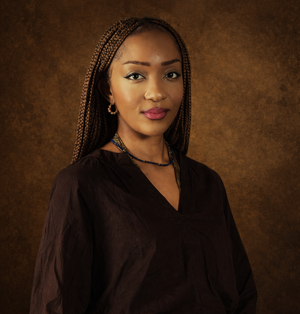
Simon Njami and The Southern Art Hub at 1-54 London: The Magic of Making the Invisible Visible
Simon Njami has a way with words and a taste for going against the grain. A thinker as much as a maker, he rejects definitions that essentialise Africa and the individual, beginning with himself. At 1-54 London, he curates Feeling Pure Magic, a group exhibition presented by The Southern Art Hub. Bringing together five artists around the invisible and the spirit, it invites us to reconnect with our humanity, our emotions and the many layers that make us who we are.
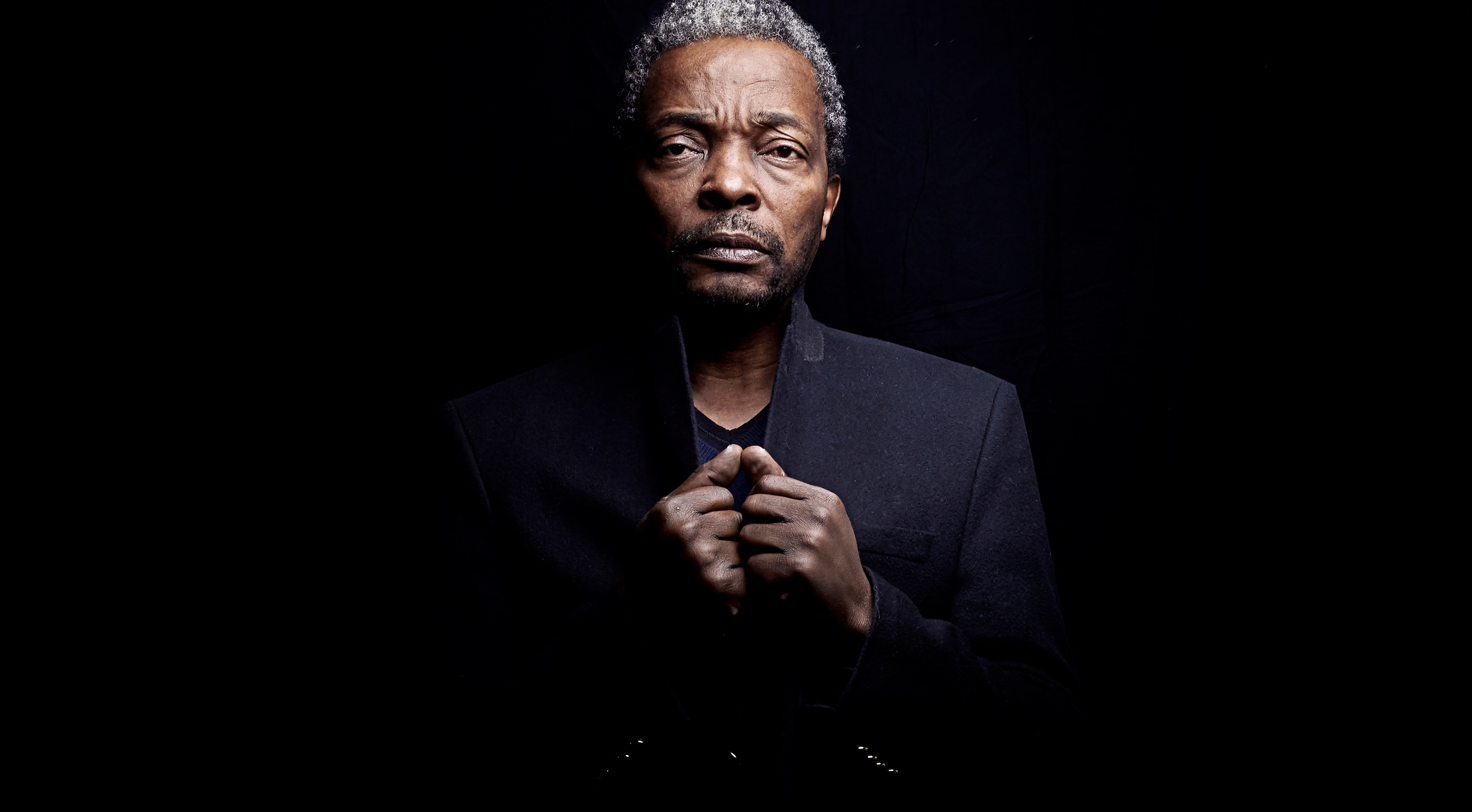
Simon DJAMI
In this conversation at 1-54 London, Simon Njami reflects on the ideas that shaped Feeling Pure Magic, an invitation to reconnect with our humanity, our emotions and our sense of being. Presented by The Southern Art Hub at 1-54 London from 15 October 2026, the exhibition brings together works by David Damoison, Bisila Noha, Luma Nascimento, Kay Gasei and Sabrina Da Silva Medeiros.
MAYÌ ARTS: What continues to spark your curiosity today?
Simon NJAMI: What sparks my curiosity… it's complicated. I'm curious by nature. After everything I've done, what interests me now are experiences that offer something new. Otherwise, I get bored very quickly.
One of those experiences, for example, is this collaboration with The Southern Art Hub. Beyond the gallery's commercial dimension, this collaboration is first and foremost about the project itself, whereas the commercial side still leaves me completely cold. What appealed to me, however, was the opportunity to show things differently, to create a genuine exhibition within a limited space and a commercial setting. That seemed worth pursuing.
MAYÌ ARTS : Feeling Pure Magic evokes both mystery and celebration. What inspired your reflections on magic, the spirit and our relationship with the invisible?
Simon NJAMI : You know, when everyone is heading in one direction, if you see someone going the opposite way, you can be sure it's me. (Laughs.) I believe we live in an increasingly dematerialised world, and artificial intelligence is part of that process. For me, art is, above all, a human affair. Cave paintings are among the earliest traces of what we would later come to call art.
I don't think that, back in prehistoric times, people relied on any intelligence other than human intelligence. And human intelligence is made up of many different components. I believe artistic creation is itself a form of magic, perhaps the most absolute form of all. How do you begin with a vague, abstract concept and gradually transform it into something you can present to others? And how can each person interpret that same thing differently?
It seems to me that we don't look at art under a microscope. We experience it through our bodies, our histories, our feelings and our cultures, in the broadest sense of the word. For every person who encounters a work of art, different connections emerge. Those connections cannot be fully described. We can try to guess at them, to give them meaning in a somewhat philosophical sense, so to speak. But there is always an element of mystery, something that remains indeterminate.
“There are still parts of the world where life itself is what matters most. In others, things are somewhat drier. It was this celebration of life and mystery that I wanted to show, in its universality, beyond any particular geographical or cultural anchoring.”
When you begin making a work, you don't really know what it will become. There is a dialogue between you and the work, between what you initially imagined and the resistance of the material. There are all the accidents that happen along the way, and the discoveries. The result does not always have to follow a predetermined plan.
It's a little like the days of analogue photography: some time would pass before you could see exactly what photograph you had taken. There was something about that process that I loved: the photographic paper had to pass through the developer, the chemical bath that finally made visible what had until then remained invisible.
MAYÌ ARTS : What does this magic reveal in today's context?
Simon NJAMI : I chose this theme because I know there is a certain confusion, a number of clichés. When people say Africa, they immediately think of spirituality. Yet the person who wrote Concerning the Spiritual in Art was not African. His name was Kandinsky. So I think there is something slightly political about this.
There are still parts of the world where life itself is what matters most. In others, things are somewhat drier. It was this celebration of life and mystery that I wanted to show, in its universality, beyond any particular geographical or cultural anchoring. Of course, the artists who created these works have their own histories. They come from somewhere. But the invisible is not exclusive to Africa.
Perhaps in Africa and the Caribbean, people are still a little more sensitive to it, still capable of deciphering certain things. But I have also met people in Japan and Australia who were equally capable of doing so.
The point is to return to that fundamental humanity we are gradually losing, to remind ourselves that, at the heart of everything, there is the human being.

Kay GASEI IAMBK Oil on reverse primed linen, 60cm x 120cm
MAYÌ ARTS: When you say that some parts of the world are "somewhat drier" in their relationship with humanity, are you referring to the modern world?
Simon NJAMI: I'm talking about the Western world. I like dealing with human beings. Human beings do not respond according to predetermined assumptions or algorithms. That's what prevents us from living in a cold world where everything would be dictated by calculations.
MAYÌ ARTS: Artificial intelligence sometimes seems to be replacing fundamental human interactions, such as seeking advice, moments of reflection or even prayer. What do we lose through this substitution?
Simon NJAMI: There is a loss, a certain dryness. When someone tells you a story, there is their attitude, everything that makes them who they are. If you ask a computer to tell the same story, you will miss what is essential to its meaning. Today, we tend to confuse efficiency, the ability to solve problems, with meaning itself.
AI may be capable of solving problems, but is it capable of grasping their meaning? Can it perceive your sadness and respond to it without consulting a database to determine how it should react? The message is simple: let us return to the human.
For me, art is the closest translator of our emotions. And emotion is something invisible. Language allows us to transform the chaos within us into signs and representations. Without that chaos, if everything inside me were organised according to a system, life wouldn't be much fun. Life is about surprise. We go outside without knowing what will happen in the street or what we might see. We have dinner with friends, we experience grief. All of that is life.
MAYÌ ARTS: Several artists in the exhibition explore memory, transmission, the body and the spirit. How did you bring their practices into conversation for this project?
Simon NJAMI: There's something very simple, and it's my secret weapon: I develop a concept, present it to the artists, and then we discuss it to see whether we share the same aspirations.
I've been working in this field for a long time, and so far, that is how it has always worked. One thing I insisted upon with each of them was that I wanted something spiritual, not spiritualist. Those are two different things.
Neither religion nor those kinds of considerations entered into our discussions. I asked them to tell me what drives them today. What makes them who they are? I tend to believe that we are like remnants, geological traces. We are made up of layers. When we utter that seemingly simple phrase, "I am", what exactly are we talking about? It was this "I am" that I wanted to explore, and I wanted them to create from that starting point.
The idea was not to fulfil a stylistic exercise but, on the contrary, to move beyond it and reveal something of themselves. Based on the elements we observe, we can begin to infer a person's history, layer by layer.
The places where we studied, the journeys we have taken, the struggles we have fought, our parents, grandparents and friends: all of these things make us who we are. Contrary to what those who seek to essentialise others would have us believe, saying, "You look like this, therefore you must be like that", a person cannot be reduced to their appearance.
You don't have to be Polish to feel the sadness in a work by Chopin. Something reaches you without passing through words. What you feel is not Chopin's sadness. It brings you back to your own sadness, because you recognise that emotion. To speak of spirituality as though the spirit belonged exclusively to one place or another is an obvious mistake.
Art can also invite you to remember, to reclaim your humanity. We are here to heal one another.

David DAMOISON 18-65-31, Vodun Voyage, Saut D’Eau, Haïti, 1992-1999 Photography 24 x 30 cm
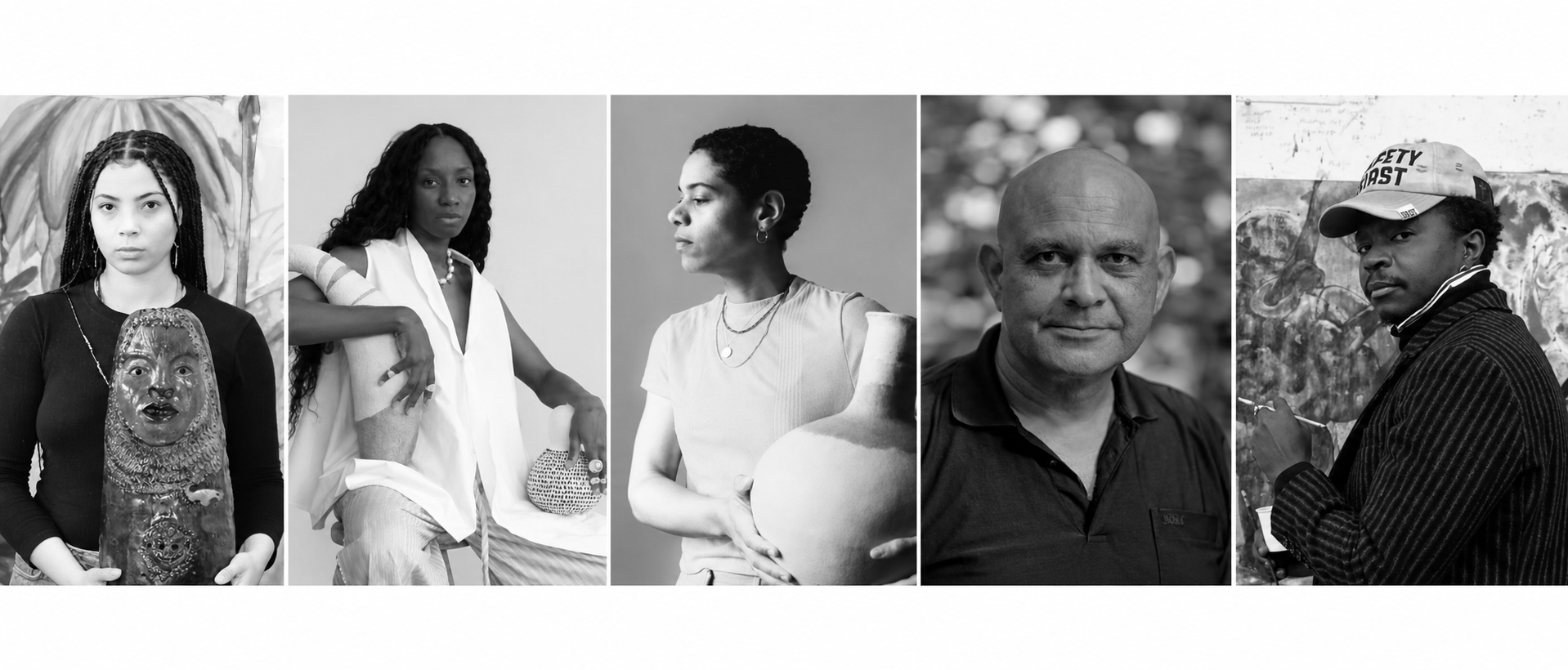
Sabrina Da Silva De Medeiros, Luma Nascimento, Bisila Noha, David Damoison, Kay GASEI
“It seems to me that we don’t look at art under a microscope. We experience it through our bodies, our histories, our feelings and our cultures, in the broadest sense of the word.”
MAYÌ ARTS: We live in a time when we sometimes forget what matters most, when our relationship with our emotions and with who we are seems increasingly blurred. It can sometimes become difficult to be fully ourselves.
Simon NJAMI: There is also a political message. Some people have an interest in essentialising others, in thinking that there is an "us" and then there are "the others". This exhibition says that there is only one "us": humanity. That is why I love art. Art doesn't spew slogans. It is simply there, open, and everyone can take from it what they wish. Art doesn't lecture people. It's like listening to someone speak: you either feel a connection with them or you don't.
And if you don't feel that connection, that's not the artist's problem. This isn't about proselytising. It's simply about reminding people of something they may have forgotten.
MAYÌ ARTS: Between family narratives, the media and perspectives coming from the continent itself, everyone tells and imagines Africa in their own way. At times, it almost appears as a form of "science fiction". Can art move beyond these representations and challenge what we call "Africa"?
Simon NJAMI: First of all, art has no language and no scientific basis. I would refer you to Valentin-Yves Mudimbe's The Invention of Africa. The problem with this invention is that it is not only external; it is also internal. There are two inventions rubbing against one another.
When I'm in South Africa and someone says, "We Africans", I ask: which African are you talking about? The Indian, the Black person, the White person?
When I'm in Morocco, some people don't think of themselves as being in Africa. That's something else again. Africa does not exist. Africa is an invention made by different people. Everyone projects a fantasy onto it, whether positive or negative.
The only thing I know is that there is a continent called Africa. Within all of this, I find an immense sense of freedom.
I believe Africans know more about the world than the world knows about Africa. Africans speak at least three languages, including their mother tongues and colonial languages, and have also learned several histories.
When some people come to me complaining, I remind them that they are also in a position of strength. I'm talking about intellectual and human strength. We must stop looking at ourselves solely through the eyes of others and begin to look at ourselves on our own terms.
That was also what guided my approach when we created an African Pavilion in Venice. Some journalists couldn't understand why artists such as Jean-Michel Basquiat, Andy Warhol and Alfredo Jaar were included.
For me, that pavilion was neither an exhibition of African artists nor an African pavilion understood simply as a geographical space. It was a space whose boundaries I could question, especially since these artists came from an island, from the continent.
Since the lines had already been blurred, I was going to blur them even further. Some people are constantly invoking Africa. It makes me laugh, because I put into it whatever I want, and they put into it whatever they want. But when they are confronted with what I put into it, they are forced to question what they themselves have placed there.
“Africa does not exist. Africa is an invention made by different people. Everyone projects a fantasy onto it, whether positive or negative. The only thing I know is that there is a continent called Africa.”
MAYÌ ARTS: Would you say, then, that Africa extends beyond geography?
Simon NJAMI: I once made a television programme for Arte called L'Afrique est ailleurs (Africa Is Elsewhere). One of the paradoxical advantages of this continent is that everyone has something to say about it.
If you say "Africa", everyone will have their own little story, their own fantasy, their own idea. That creates the potential to shift perspectives. When something has not yet been constructed — and for me, that is the case with contemporaneity and artistic creation — you have no choice but to move forward, to experiment and find your way. When something has already been constructed, there is only one choice: to tear it down. But Africa is in perpetual motion.
It is like a turbulent sea that extends far beyond its territorial boundaries and spreads everywhere.
MAYÌ ARTS: How can we shift these perceptions and rebalance the way we see one another?
Simon NJAMI: "Here are Black men standing, looking at us." That is how Jean-Paul Sartre introduced his Black Orpheus. It evokes the gaze, but also the unsettling experience of being seen. Those who are looked at are not merely objects of observation. They are looking back at us. Perceptions are part of being human. We all have them. No perception or prejudice is superior to another. Beginning to think from that position can already help to rebalance things.
MAYÌ ARTS: Looking back, how have perceptions of African artists and their place in major international art events evolved since your earliest projects?
Simon NJAMI: It's very simple. For a long time, a large part of the world was designated terra incognita, unknown territory. Yet some people knew that territory very well. Others had simply decided that it was unknown. As a result, you wouldn't have seen a non-Western artist included in these so-called international events.
For a long time, contemporaneity was confined within definitions. Then you either accepted those definitions or you didn't. I have always rejected dictates.
I remember taking part in a debate in 1991 with Yann Hoop, who has since become a friend. He had just returned from a trip and told me there was nothing in Africa. I was rather fierce in those days, so I gave him a lesson and handed him the first issue of Revue Noire.
Three months later, he was asking me for the contact details of three artists. There are multiple centres, multiple poles.
The problem is that people have been led to conceive of the world as though there were only one centre. Everything outside that centre remained in darkness. As though, when the sun wasn't shining here, it was night everywhere else.
The intellectual struggle against ignorance remains immense. Of course, things have evolved. We have gone from zero to something. But our role remains to open up the world, to open people's eyes. That is why I teach. We must return to Aimé Césaire's idea of the universal as the sum of all particularities. Without those particularities, all that remains is a monolithic whole, where everyone does the same thing, wakes up at the same time, goes to bed at the same time, speaks the same language and thinks the same thoughts.
Art prevents monolithic thinking. It allows us to open windows, open doors, and breathe.

Feeling Pure Magic, curation Simon Njami pour The Southern Art Hub à 1-54 Londres 2026
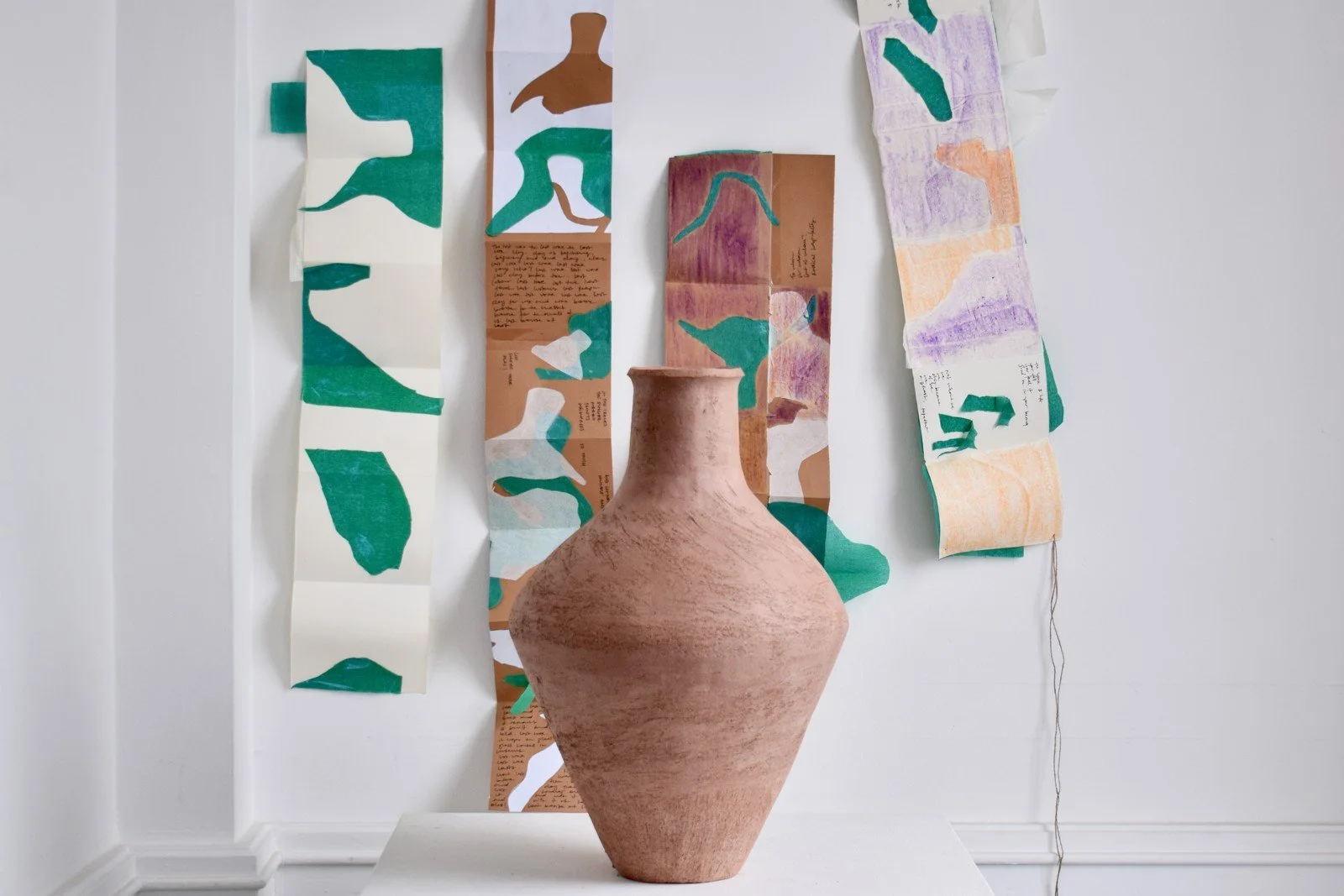
Bisila NOHA The Lost Bronze, Clay, 2026 Clay 50 x 30 cm
MAYÌ ARTS: How does this "pure magic" manifest itself within the exhibition space?
Simon NJAMI: There's something you don't know about me: I never put my name to anything I haven't personally chosen.
I like going against the grain of my own experiences, and something tells me this space will be unique. During my conversations with Abraham (Abraham Abia, founder of The Southern Art Hub), I told him that I am a curator, and therefore simply hanging things on walls doesn't interest me. Even though we are operating within the context of an art fair, I want the works to be displayed with great precision.
If people want to see more, there are catalogues and other ways of providing information. This is not a shop. Feeling Pure Magic is an exhibition in which every element has been considered so that visitors feel they are entering a particular kind of space.
MAYÌ ARTS: So you distinguish between presenting artworks and creating the experience of an exhibition.
Simon NJAMI: There is presentation, a word I leave to the showroom, and then there is the exhibition, the act of curating. Creating an exhibition is not simply about presenting things in an aesthetically pleasing way. It can even create a sense of anxiety. The point is to make sure that when people enter a space, they feel something.
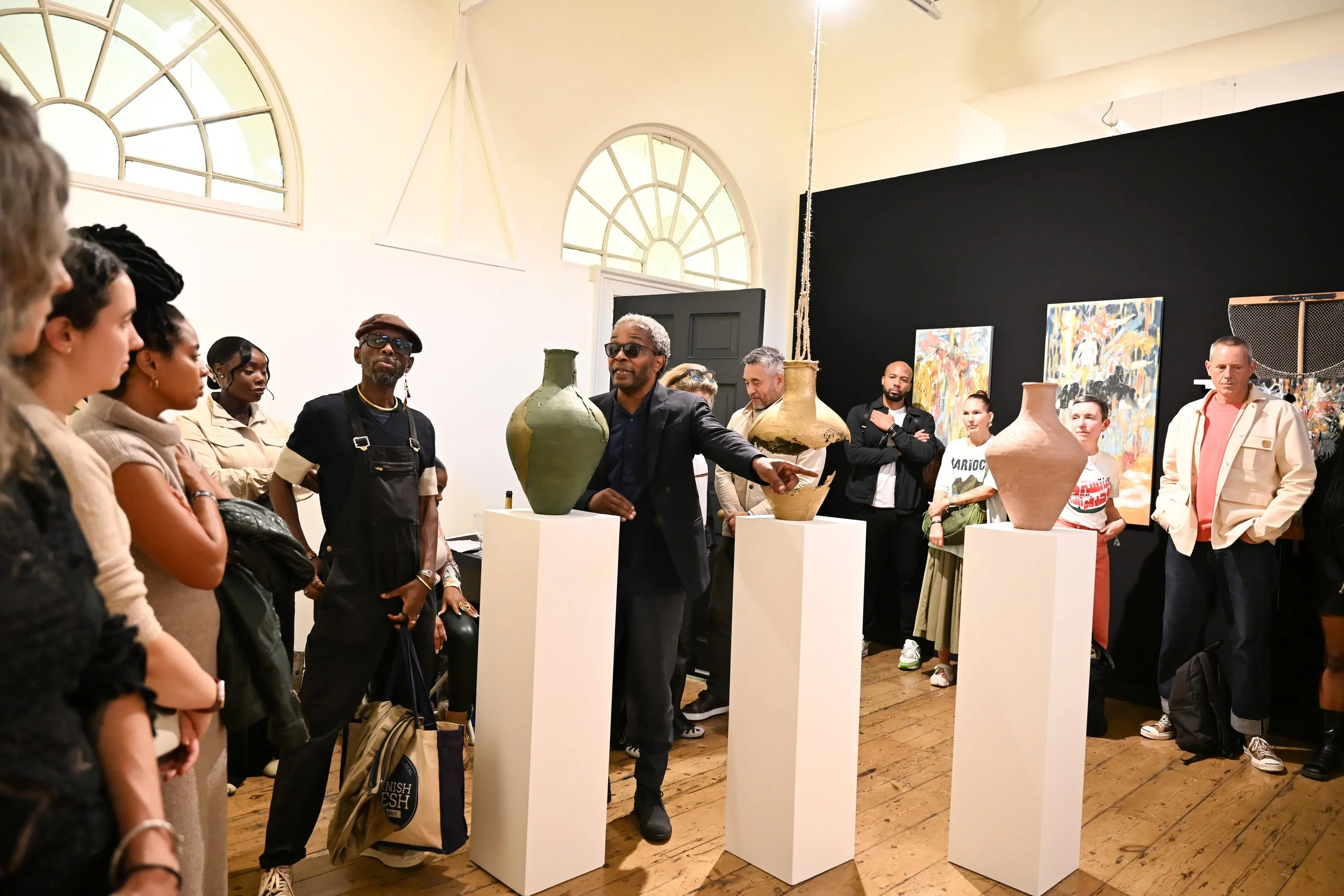
Feeling Pure Magic, curated by Simon Njami for The Southern Art Hub et 1-54 London 2026
Feeling Pure Magic : David Damoison, Bisila Noha, Luma Nascimento, Kay Gasei and Sabrina Da Silva Medeiros. Curated by Simon Njami. Presented by The Southern Art Hub at 1-54 London, from 15 October 2026.