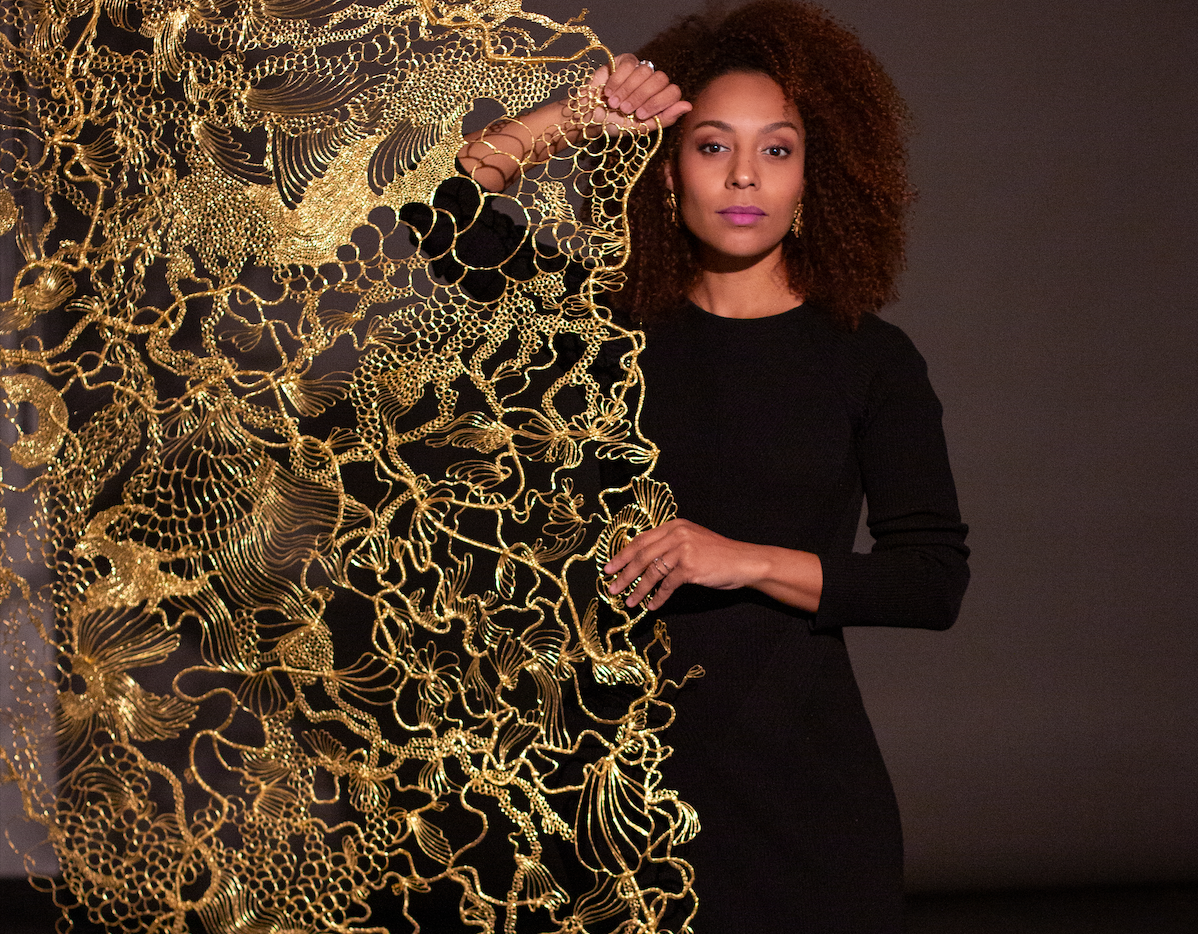
Between strength and fragility, resilience and delicacy, Marie de Decker’s works command a singular presence. Gold, fishing nets, textiles and pearls form a visual language in which material engages with space and emptiness, revealing invisible stories and memories. Working across Luxembourg and Mauritius, the artist has developed a practice rooted in textile art and sculpture. Drawing on her Flemish and Fulani heritage, as well as childhood memories, she explores the connections between material, genealogy and the transmission of knowledge across generations.
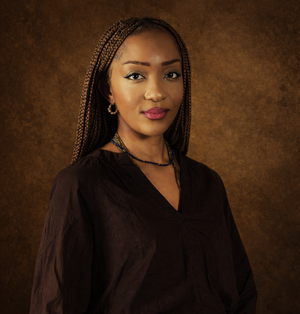
Portrait de Marie De DECKER. credits : Oksana Starikova
When we meet Marie de Decker, the artist is experiencing a particularly prolific period in her career, with five exhibitions taking place in succession or simultaneously, from Venice to Brussels, including Africa Legacy. Yet behind this flourishing activity lies a more intimate reflection on memory, genealogy and the passing down of knowledge. A seeker of gold, Marie de Decker also traces the threads of her own ancestry and, by extension, those of humanity itself. Through her works, she weaves connections between generations, materials and the origins of life, drawing in particular on fishing nets collected from the mangroves of the Indian Ocean. In this conversation with MAYÌ ARTS, the artist reflects on her distinctive relationship with materials, the dialogue between her African and European heritage, and a conviction that runs throughout her practice: an artwork carries within it a story, a memory and something that will outlive us.
MAYÌ ARTS: Your work was recently exhibited in Brussels at Africa Legacy, where a monumental piece highlighted your distinctive relationship with materials. How did this connection develop, from gold and fishing nets to textiles ?
Marie de Decker: Material is undoubtedly what fascinates me most, particularly because of its history. I believe that a material never ends up somewhere by chance. It has passed through different states and places that have transformed it and left their traces. The people who have encountered it have also left their imprint. It is all these stories we know nothing about, but which the material itself can reveal, that I try to tell through my work.
That is why it is so important for me to use materials that, for instance, have spent a long time in the ocean. The depths of the sea are full of things that remain unknown to us. And the same is true of nature more generally: we think we know it, yet it is a world made up of things we cannot see, things we have never seen or experienced. In a way, these materials that have spent time in the ocean have passed through that unknown world and can, in turn, teach us something. I believe that it is precisely the things we do not yet know that will help future generations avoid repeating our mistakes, or at least move forward, go further, and gain a greater understanding of the world.
MAYÌ ARTS: Where does your connection to the mangroves, which feature so prominently in your work, come from ?
Marie de Decker: My work spans several geographies and two different hemispheres, simply because I live in two places: Poudre d’Or, a village in the northeast of Mauritius, and the Grand Duchy of Luxembourg, where I live on the edge of a forest.
So my work evolves between a forest on land and a forest on water.
“In a way, these materials that have spent time in the ocean have passed through that unknown world and can, in turn, teach us something.”
MAYÌ ARTS: The idea of transmission, and genealogy in particular, seems central to your work, especially in Les Jeunes Filles à la Perle, presented in Paris this autumn. Could you tell us how this work came about ?
Marie de Decker: This is not a series of separate works, but a single, evolving work that will continue to grow. It tells a story that connects with what I was saying about materials. In a way, we are the result of everything that came before us.
I like to bring to light everything we do not know, but which lives within us without our even being aware of it. Our ancestors, for example. We know our parents, our grandparents and, if we are particularly fortunate, our great-grandparents. But beyond that, it is rare to have any records, or even a family history to draw upon.
The story behind Les Jeunes Filles à la Perle began with a childhood memory. My grandmother had a reproduction of a painting by Vermeer in her home. I am half Flemish and half Fulani, from Mali, and whenever I visited her, I spent a long time believing that the painting was a portrait of a great-great-aunt, a woman in our family to whom we owed a great deal. She was the only person whose portrait was displayed in such a beautiful, imposing frame. And the painting looked old. I imagined that she was a relative who had already passed away and who must have accomplished extraordinary things during her lifetime. I thought she must have done something very important to deserve such a prominent place in the house, and that we therefore owed her tremendous respect and gratitude.
I was fascinated by that painting. My grandmother kept explaining that the girl was absolutely not a member of our family, but the painting had actually belonged to her great-aunt. So when she mixed up the stories a little, I became completely confused anyway!
In my mind, there was simply this great-aunt and the painting hanging there. In a way, I always identified with that young woman. I imagined that she represented my ancestors when they were my age, that perhaps they had looked something like her in their youth. And that all these women, even those I had only known as elderly women, had themselves once been young girls.
MAYÌ ARTS: What stories do these pearls tell ?
Marie de Decker: The pearl echoes my Flemish origins. Pearls feature prominently in representations of femininity, particularly in Renaissance painting and, more broadly, in the work of the Early Netherlandish painters.
There is also this whole question of lace and textiles, which are very present in painting. But beyond their representation, lacemaking was also a craft practised by women, one that brought entire regions to prominence. When I speak of Flanders, I do not mean only northern Belgium, but Flanders in the broader sense, stretching from northern France to Holland. All these regions ultimately became very wealthy thanks to the textile industry. And the people who sustained that industry were women. Women who, unfortunately, often remained invisible and lived in poverty. My grandmother was herself a sewing teacher. She taught me and passed on all the techniques of embroidery, knitting, cross-stitch and crochet that I celebrate in my work today.
MAYÌ ARTS : There is clearly a deeply personal attachment to this work.
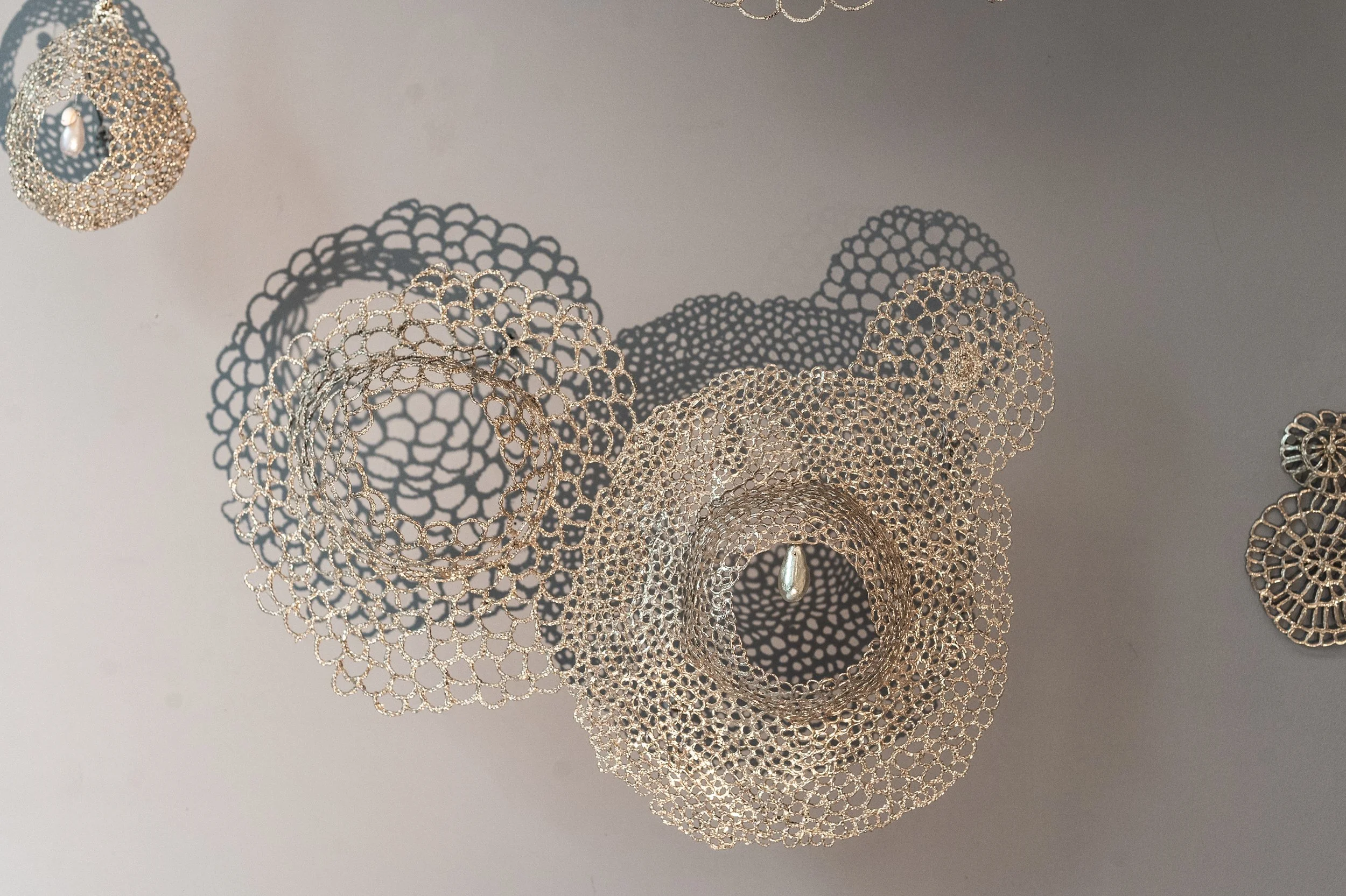
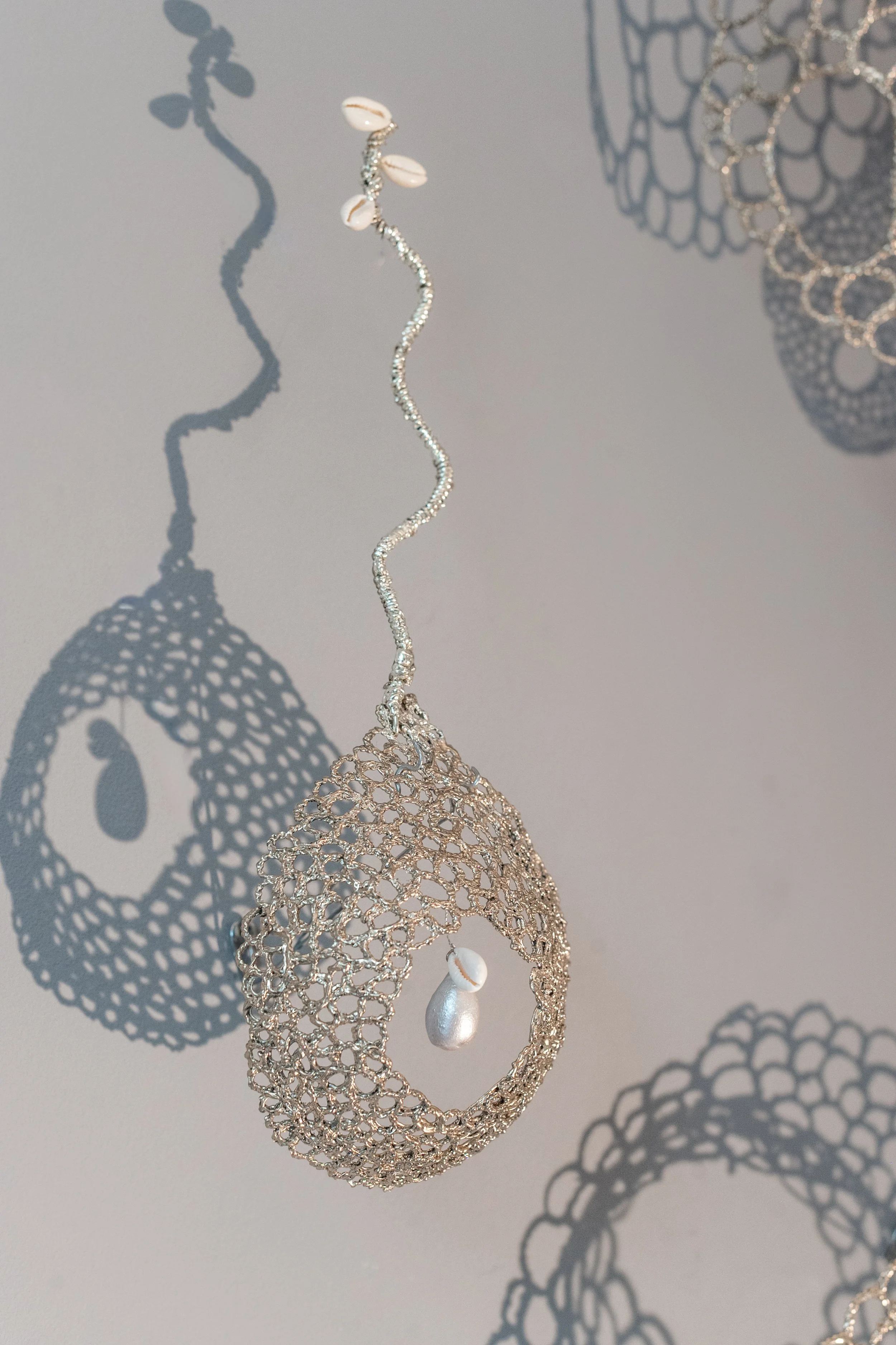
Marie de Decker: Les Jeunes Filles à la Perle is a celebration of the women who came before me, but also of textiles, which contributed to the prosperity of so many regions, whether in Flanders or across Africa, through weaving, textile production and the traditional skills of different peoples and regions of the continent. These Jeunes Filles à la Perle celebrate my ancestors by tracing the thread, quite literally, of my family tree. But they also extend beyond my own genealogy to encompass the family tree of humanity as a whole. Because if we follow that thread far enough back, we eventually arrive at marine organisms, and then single-celled organisms, our earliest ancestors.
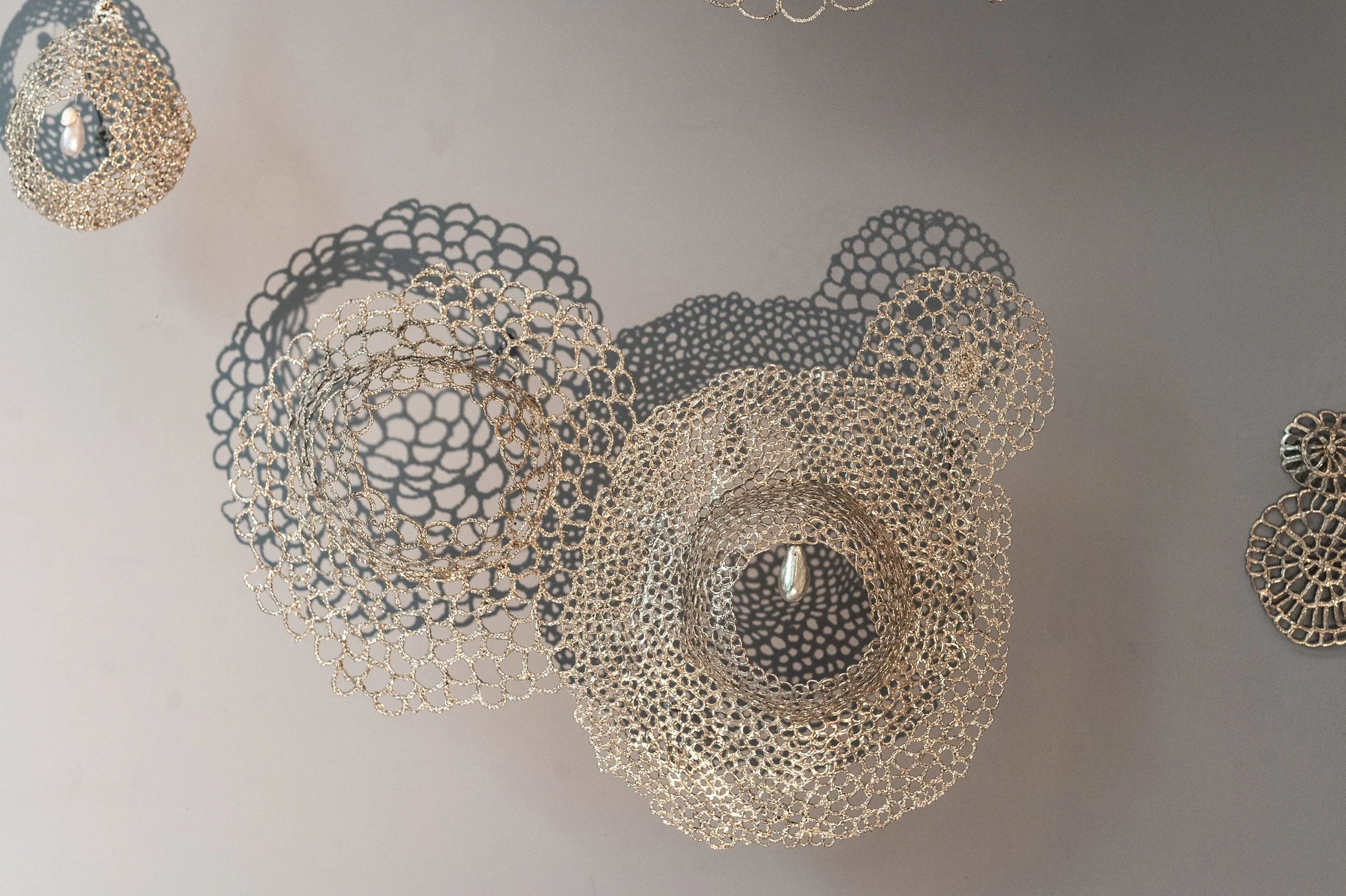
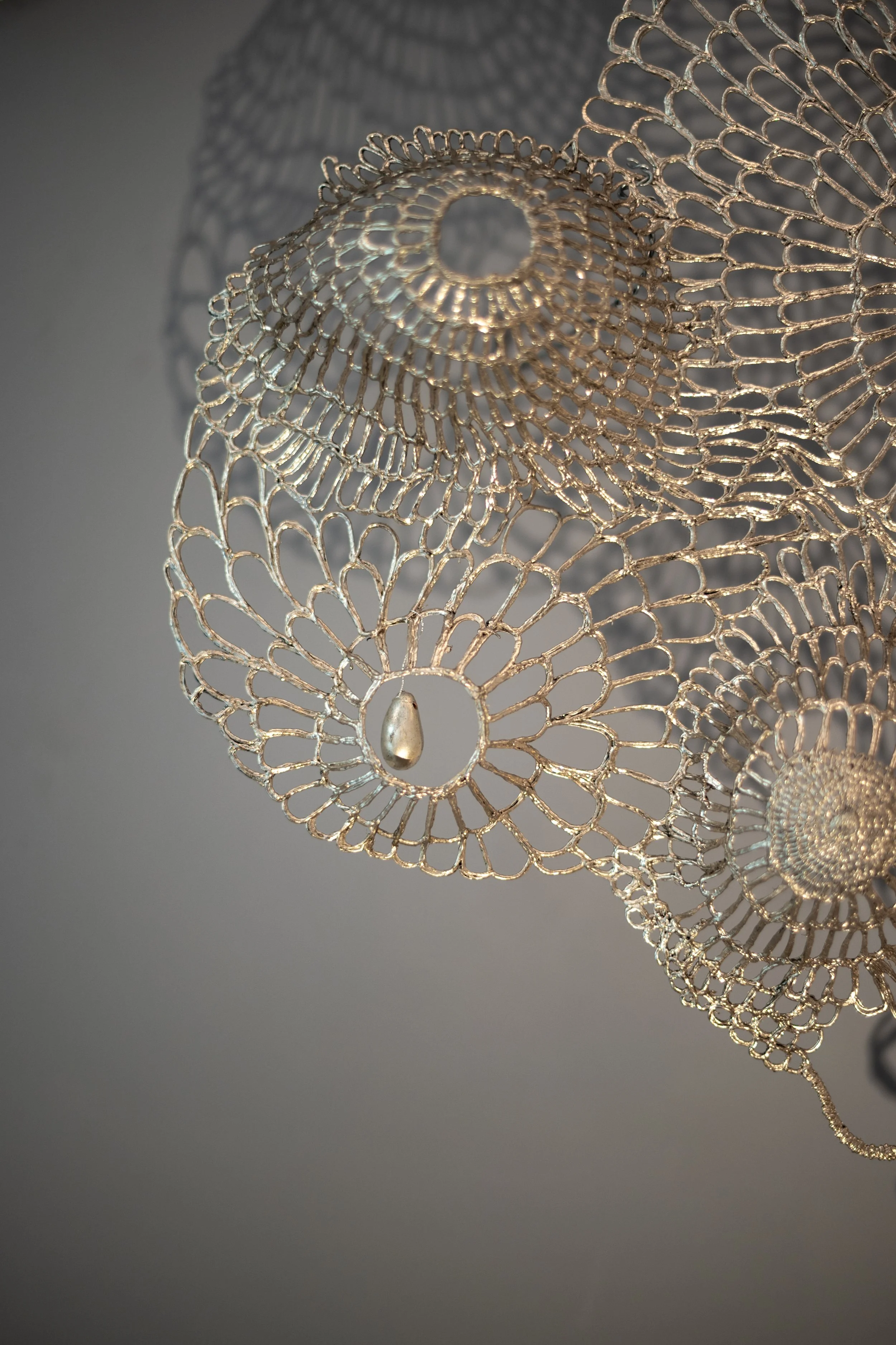
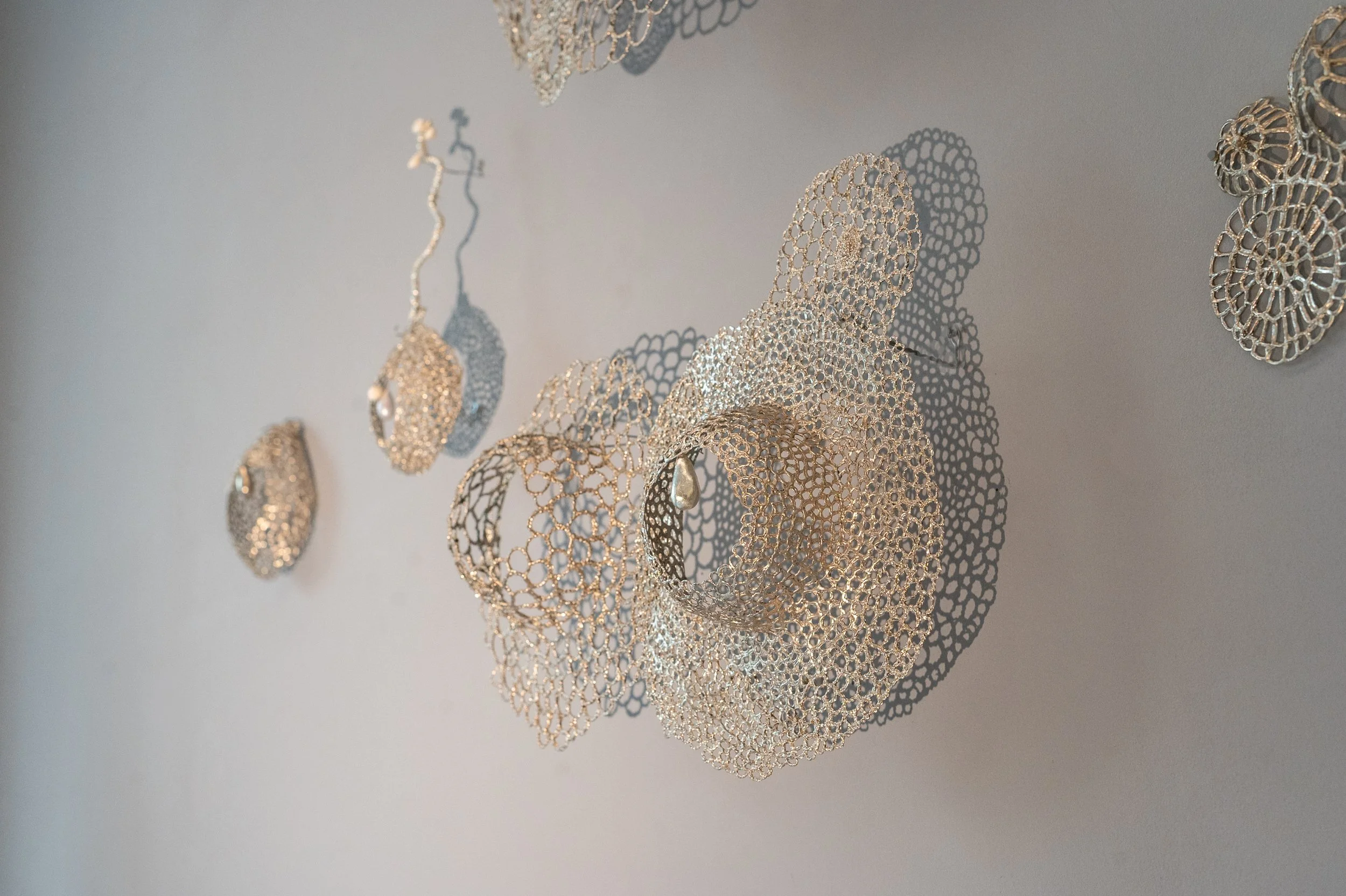
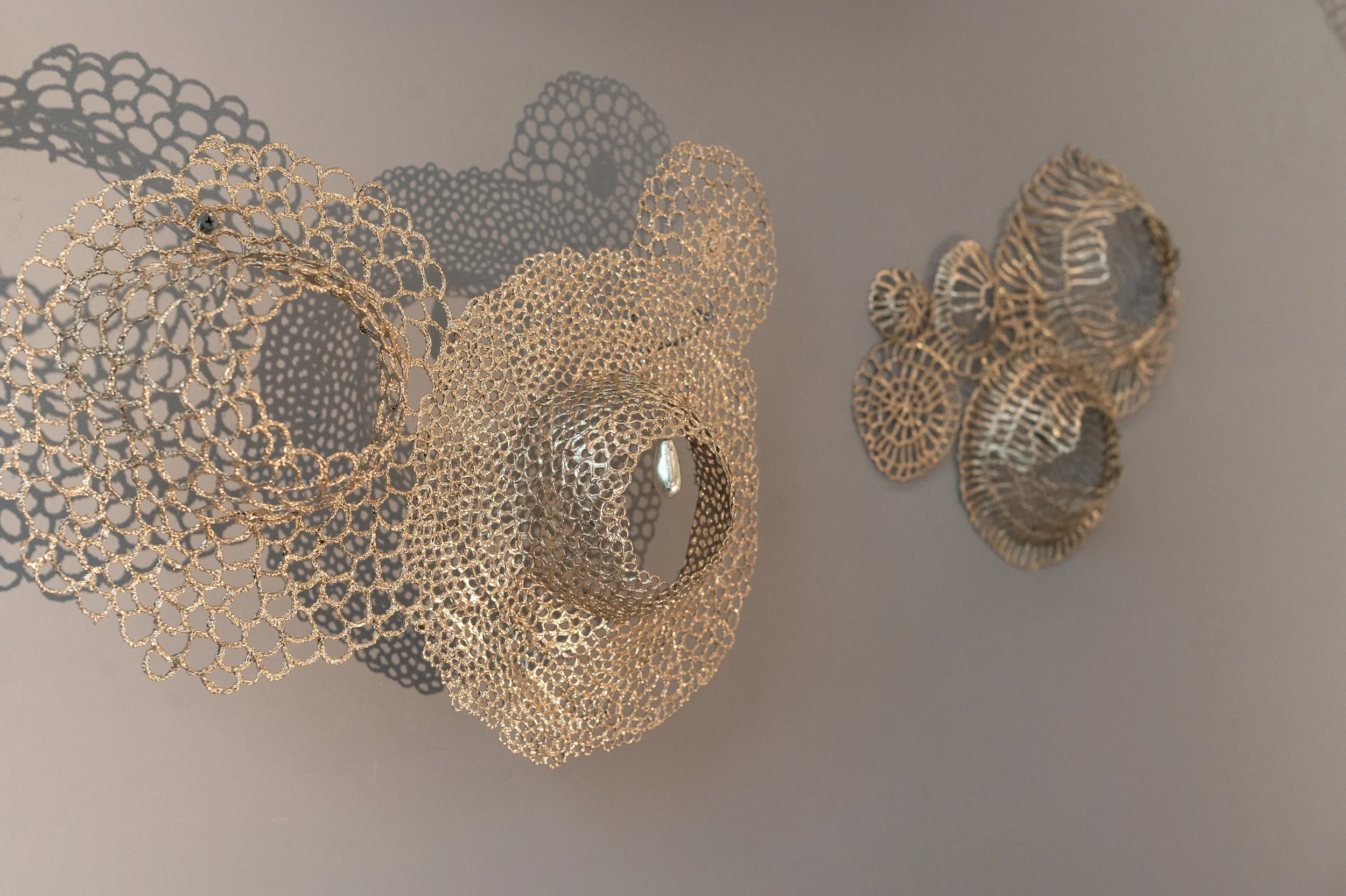
MAYÌ ARTS: Do you feel particularly drawn to any of these female figures, or do you see yourself more as part of a continuing lineage of women who came before you ?
Marie de Decker: I feel particularly close to my grandmother. She was the person who really took me under her wing when I needed it during my childhood. She introduced me to culture and to working with my hands, alongside my grandfather, who had been a monk at an abbey in Orval before leaving the religious order when he met my grandmother and decided to build a life with her. He gave me my first camera and introduced me to art. He also practised weaving. Both of them were deeply committed to intellectual enrichment. We used to visit exhibitions together.
I remember my grandmother constantly cutting out little newspaper articles and sending them to me by post, from publications I did not necessarily have access to. They covered fashion, current exhibitions and other cultural subjects. She really played an incredibly active role in my cultural awakening. Far beyond what one might normally expect from a grandmother, especially as I did not have the opportunity to grow up with the daily presence of both a mother and a father.
MAYÌ ARTS: We tend to associate gold with power and wealth, yet your work seems to give it a different significance. What is your relationship with this material?
Marie de Decker: I spent the early years of my artistic career working as a portrait photographer, following what my grandfather had taught me. A researcher at heart, I wanted not only to master new techniques but also to develop my own, expanding the range of possibilities available to me.
It was in this context that I began experimenting with my photographic prints, particularly by incorporating gilding. I was looking for a process that would allow me to move beyond the two-dimensional nature of a photographic print, giving it another quality, something capable of withstanding the passage of time. I was searching for materials that were resistant, that would not deteriorate, and that could offer a different interpretation of the image. I began exploring gold, first by applying gilding to my photographic prints, then by working directly with images in metal, eventually producing photographic prints made entirely with gold.
And the more I worked with this material, the more I became aware of its truly distinctive energy. When I was in my studio, I never felt alone. I genuinely had the sensation that the space was inhabited by an energy that was somehow different from what I was used to. I began wondering whether this feeling might come from the gold itself, which was a completely new material for me, something I had never used before. And I started thinking that perhaps gold had another purpose beyond simply being applied to a flat surface, as is traditionally the case with gilding, where it is rarely explored through volume or within space.
Gold is a metal whose history stretches back to the origins of the universe and which, in a sense, carries that entire history within it, along with all the knowledge of the world. I find it an extraordinarily powerful material. And above all, it will still be here long after we are gone.
This means that whenever I create something with gold, I have to be conscious that the work will outlive me. The gold will continue to exist long beyond my own lifetime. In a way, I believe I have a responsibility to make the message I convey through this material as universal and as truthful as possible. It should not simply reflect a fleeting thought, a passing concern or a political or economic influence.
Life is but a series of cycles. What is true today may no longer be true tomorrow, but it might become true again one day. So it is important for me to tell a story that can transcend different eras and retain its meaning in both the Northern and Southern Hemispheres. When you live in very different places, you realise that people do not face the same problems or share the same concerns everywhere. A work that carries a particular meaning in one geographical location will not necessarily have the same significance elsewhere. That is why I believe the message conveyed by an artwork should be able to transcend geographical boundaries and the concerns of the present moment. It is this universal dimension that I strive to achieve in my work.
“...And the more I worked with this material, the more I became aware of its truly distinctive energy. When I was in my studio, I never felt alone. I genuinely had the sensation that the space was inhabited by an energy that was somehow different from what I was used to”
MAYÌ ARTS: Your Flemish and West African heritage seem to coexist naturally within your artistic practice, even as you explore other cultural traditions. How do you bring these different identities into dialogue?
Marie de Decker: I am deeply interested in the history of peoples. I think it is important not to think exclusively in terms of borders: Belgium, France, Mali or Senegal. Behind these nations are, above all, peoples who have travelled, carrying their knowledge, skills, traditions and cultures with them. And that is precisely where their immense richness lies. Every culture has its own particularities, but there are also many similarities between them. Some cultures have encountered one another throughout history, while others have developed similar practices because they were responding to the same needs.
These connections are not necessarily recorded in history books, but they become apparent when we take the time to observe. Take textiles, for example, which we were discussing earlier. I find it fascinating how they transcend peoples and civilisations. Textiles exist in almost every culture because, at some point, we have all needed to clothe ourselves. Depending on the region, available resources and social class, different peoples have developed their own weaving techniques, patterns and uses. Ultimately, when I look at my two cultural heritages, I discover so many similarities that the dialogue between them happens quite naturally. I would not say it is always easy, but these shared elements allow them to coexist without my having to place them in opposition.

Further Than Here, Technique mixte, or 24 carats, Diamètre : environ 165 cm, 2025, exposée à Africa Legacy en 2026. Credit : Marie De DECKER
Marie DE DECKER : If I exist today, with origins that are not necessarily a common combination between these two regions of the world, then there must be a history behind it all. I began asking myself a lot of questions: were there others before me? I grew up mainly with my European family, surrounded by a culture that was not African at all, and sometimes feeling a little alone in the world. I would think to myself: But surely, my parents met in Paris, in France, but throughout history, were there other West Africans and Northern Europeans who came into contact, who formed connections?
And the answer is clearly yes. There have been numerous exchanges since the Renaissance, and even before the period of the slave trades, with Europeans travelling to Africa and Africans coming to Europe, particularly for trade, but also as ambassadors, representing their cultures and ways of life through various forms of exchange. And I find that this aspect is very rarely highlighted in representations of relations between Europe and Africa.
We are often presented with a sort of duality, as though we must be either one or the other, or somehow more one than the other. Today, I do not consider myself more one than the other. I do what I can, at my own level, with what I have come to understand about my existence and the world. And ultimately, it feels quite natural to me to approach things this way.
“I love the idea that art can pass something on.”
MAYÌ ARTS: What does your artistic practice teach you today? What does it bring you personally?
Marie de Decker: Well, I have a story about that, one that is part of my personal history. Unfortunately, I lost my best friend to cancer a few years ago. Two or three years after she passed away, the Fondation Cancer in Luxembourg contacted me and invited me to create a work for a charity auction in support of the foundation. The work eventually sold for 40% above its estimate. And I thought to myself: Just look at that!
At the beginning, there was nothing. And because I initiated the creation of an artwork, that work came into existence and helped raise funds that will help people live, overcome this disease, and perhaps enable researchers to find treatments for something so devastating. And that is tangible. I mean, there is nothing worse than losing someone close to you. But the idea that art can somehow contribute to finding solutions so that this happens less often, or perhaps one day no longer happens at all, that it can at least allow us to do something in the face of such suffering, I find that extraordinary and incredibly powerful. That work will help the Fondation Cancer, but it will also endure within the family of the collector who acquired it.
In a way, it will contribute to a certain form of intellectual or spiritual enrichment for that family, and for the generations that follow. I love the idea that art can pass something on. It is also what I feel when I see children visiting the Africa Legacy exhibition.
Seeing someone who does not necessarily know anything about art, who sometimes cannot even read yet, experience an emotion, be moved by an artwork to the point of wanting to interact with it, walk around it, hide behind it, see things in it and understand things in their own way.
For me, there is nothing more beautiful.
Discover Marie de Decker’s works at art.mariededecker.com.